Agentic workflow automation describes software that is given a goal rather than a script. A person states the outcome, hands the software a set of tools and a boundary it cannot cross, and the software works out the sequence of steps on its own while the job is running. If a step fails or returns something unexpected, it picks a different route instead of stopping.
That one difference, who chooses the next step, separates it from every automation technology that came before. A macro, a rule engine, an RPA bot and a scheduled batch job all run a path that a human drew in advance. An agentic workflow draws the path as it goes.
The phrase has also been stretched past usefulness by marketing, to the point where Gartner gave the practice its own name. A test that separates the real thing from the relabelled thing is therefore worth more than any feature list, and that is where this guide starts.
A definition anyone can follow
Two ways of getting to an unfamiliar address make the distinction concrete.
Printed directions are an ordinary automation. Turn left at the petrol pump, continue for two kilometres, turn right after the school. The instructions work perfectly until the road is closed. Then they are worthless, because the person who wrote them never saw the barricade, and paper cannot improvise.
Satellite navigation is the agentic version. It is given a destination instead of a route. It holds a map, a live traffic feed, a record of closures and a rule that it must stay on legal roads. When the road closes, it recalculates. Nobody wrote the detour in advance, and nobody needs to.
An agentic workflow is the second kind of system. The goal is fixed by a human. The route is chosen by the software, step by step, from whatever the situation looks like at that moment.
The one-sentence version
Traditional automation executes a decision that a person already made. Agentic automation makes the decision at the moment of execution, inside limits a person set beforehand.
Three generations of automation, side by side
Agentic workflows did not arrive to replace what came before. Most organisations that run them also run rule engines and RPA bots, because the older methods are cheaper and more predictable for the work they suit. The table sets out what actually changes between generations.
| Dimension | Rule-based workflow | Robotic process automation | Agentic workflow |
|---|---|---|---|
| Instruction given | An exact path: if this, then that | An exact path, plus screen coordinates and clicks | A goal, with tools and a boundary attached |
| Who picks the next step | The author, before the run | The author, before the run | The model, during the run |
| Input it handles | Structured fields only | Structured fields and fixed screen layouts | Structured records plus documents, email, images and free text |
| Unanticipated case | Stops or throws an error | Breaks, often when a page layout shifts | Attempts a different route, or escalates |
| Behaviour when it fails | Identical every time | Identical every time | Varies between runs on the same input |
| Change management | Rewrite the rule | Re-record the bot | Revise the goal, the tools or the guardrails |
| Audit trail | Trivial to read | Trivial to read | Needs deliberate instrumentation of each step |
| Natural home | Approvals with clean thresholds | Moving data between systems without an API | Exception-heavy work that currently reaches a human |
Table 1. The generations are complementary. Teams with mature RPA programmes typically keep their bots for structured execution and add agents for the exceptions those bots escalate.
The Runtime Discretion Test
Vendor language is unreliable, so a short test is more useful than a definition. Four questions decide whether a system deserves the label. A product that cannot answer the first two in the affirmative is automation with a language model bolted somewhere inside it.
| # | Question | Answer that means agentic | Answer that means scripted |
|---|---|---|---|
| 1 | Who selects the next action once the run has started? | The model, from the state it observes | A branch the author wrote beforehand |
| 2 | Can the system take a path nobody enumerated? | Yes, within its permission boundary | No, every path exists in the configuration |
| 3 | Does it act on systems, or only produce text? | It calls tools that change real records | It drafts output for a human to apply |
| 4 | Does it evaluate its own result and retry? | Yes, it reads the outcome and adjusts | No, it reports success or failure once |
Table 2. The Runtime Discretion Test. Questions one and two establish autonomy. Questions three and four establish whether the autonomy does anything.
Anthropic, whose engineering team published one of the more widely cited taxonomies in the field, draws the same line with different words. It groups everything under agentic systems, then separates workflows, where language models and tools are orchestrated through predefined code paths, from agents, where language models dynamically direct their own processes and tool usage.
The distinction matters commercially. A workflow built on authored rails is predictable and cheap to audit. An agent choosing its own path handles cases nobody anticipated, and costs more in tokens, latency, oversight and review effort. Most production systems combine the two, using fixed logic for validation and approvals while reserving model discretion for the judgement calls.
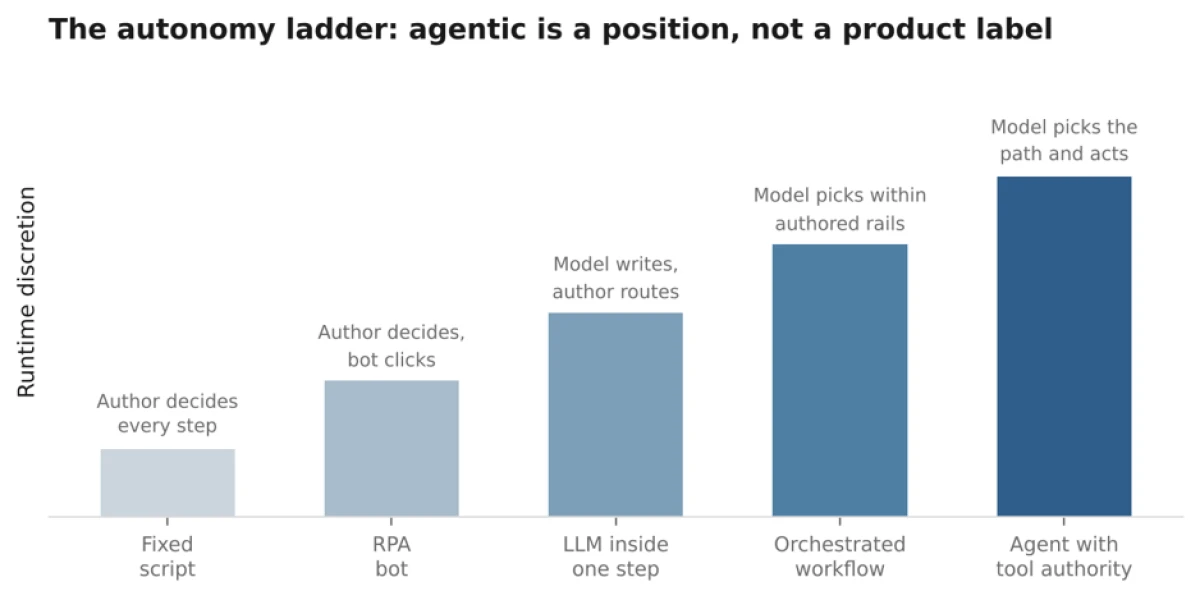
Figure 1. Autonomy sits on a continuum. The useful question is not whether a system is agentic but how much runtime discretion it has been granted, and whether that amount suits the work.
What an agentic workflow is made of?
Strip away the branding and the same six components appear in almost every working system. Missing any one of them produces a familiar failure.
| Component | What it does | What breaks without it |
|---|---|---|
| Goal | States the outcome in terms a model can check itself against, such as a resolved ticket or a reconciled invoice | The system wanders, because nothing defines done |
| Reasoning model | Reads the current state and decides the next action | Nothing is left but a rule engine |
| Tools | Give the model hands: database queries, API calls, file operations, searches | Output is advice rather than work completed |
| Memory | Carries context across steps and, in longer-running systems, across sessions | The model re-derives facts it already had, sometimes differently |
| Feedback loop | Reads the result of each action and feeds it back into the next decision | Errors pass downstream silently and compound |
| Guardrails | Define permissions, spending caps, step limits and the actions that require a human signature | Small mistakes become unrecoverable ones |
Table 3. The anatomy of an agentic workflow. Guardrails are the component most often added after an incident rather than before.
Tool access has become the practical bottleneck, which is why an integration standard mattered more than another model release. The Model Context Protocol, published as an open standard in November 2024, gave agents one way to discover and call external systems instead of a bespoke connector for every pairing. By October 2026 the ecosystem had passed 10,000 public servers and roughly 97 million monthly SDK downloads, and competing vendors had shipped compatible tooling. Integration moved from custom engineering toward infrastructure.
The patterns builders actually assemble
Working systems are built from a small catalogue of arrangements rather than from one grand architecture. Two taxonomies dominate practice. Anthropic published five workflow patterns in December 2024. Andrew Ng named four agentic design patterns in March 2024, two of which have already appeared here as the feedback loop and the toolset. The remainder are routinely combined inside a single deployment.
| Pattern | How it works | Suits |
|---|---|---|
| Prompt chaining | Splits a task into sequential calls, each working from the previous output, with programmatic checks between steps | Work with a clean, fixed sequence where accuracy matters more than speed |
| Routing | Classifies the input and sends it to a specialised prompt, model or path | Mixed inbound volume where one prompt cannot serve every case well |
| Parallelisation | Runs several calls at once and combines the results, either by splitting subtasks or by voting on the same task | Independent subtasks, or decisions that benefit from a second opinion |
| Orchestrator and workers | A central model decides the subtasks at runtime, delegates them and synthesises what returns | Work whose subtasks cannot be listed in advance, such as edits spread across many files |
| Evaluator and optimiser | One model produces an answer while a second critiques it, and the loop repeats until the critique is satisfied | Tasks with clear quality criteria where critique measurably improves output |
| Planning | The model decomposes a goal into executable steps and adapts the plan as results arrive | Open-ended work, though Ng flagged this pattern as less mature than the first two |
| Multi-agent collaboration | Specialised agents with distinct roles and tools coordinate through a pipeline, a manager or open messaging | Problems with genuinely separate specialisms, at the cost of more failure modes |
Table 4. The first five patterns come from Anthropic's engineering taxonomy. Planning and multi-agent collaboration come from Andrew Ng's design patterns, which also cover reflection and tool use, both described earlier in this guide.
The guidance attached to both taxonomies points the same way: start with the simplest thing that works. A single well-prompted model call with retrieval attached solves a surprising share of what gets scoped as an agent project. Complexity buys capability and charges for it in latency, cost, oversight and the number of ways a run can go wrong.
The arithmetic that decides whether it works
One piece of arithmetic explains more agentic project failures than any discussion of model quality, and it rarely appears in a vendor deck.
When steps depend on one another, reliability multiplies rather than averages. A workflow of ten dependent steps, each succeeding 95 percent of the time, finishes correctly on roughly 60 percent of runs. Push the same per-step reliability to twenty steps and the figure falls to about 36 percent. Nothing is broken. That is simply what repeated multiplication does.
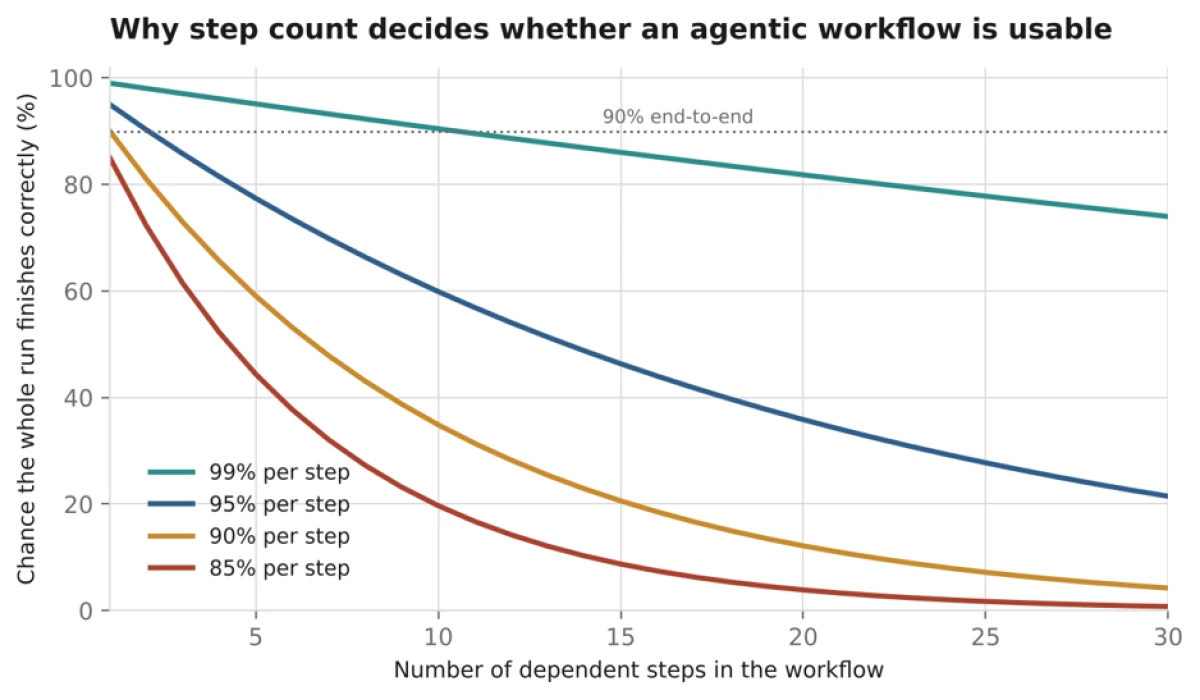
Figure 2. End-to-end success against step count. The curve is the reason short, checkpointed workflows outperform ambitious long-horizon ones.
| Per-step reliability | 5 steps | 10 steps | 20 steps | 30 steps |
|---|---|---|---|---|
| 99 percent | 95% | 90% | 82% | 74% |
| 95 percent | 77% | 60% | 36% | 21% |
| 90 percent | 59% | 35% | 12% | 4% |
| 85 percent | 44% | 20% | 4% | 1% |
Table 5. Chance that a full run completes without an error, calculated as per-step reliability raised to the number of steps.
Three levers change the outcome. Raise per-step reliability, which has a ceiling because no model reaches perfection on non-trivial work. Shorten the chain, which is usually the cheapest intervention available. Add recovery so a failed step does not end the run, which breaks the multiplication rather than merely slowing it.
Recovery deserves particular attention because the gain is larger than intuition suggests. A five-step process at 95 percent per-step reliability succeeds on about 77 percent of runs when a failure is fatal. Give it the ability to recover roughly half the time and that rises to about 91 percent, a level that absorbing failures would require near-perfect steps to reach.
Why this matters before procurement
A demo shows one successful run. Production shows the distribution. Asking a vendor for trajectory success rate across complete runs, rather than per-step accuracy, surfaces the gap before a contract is signed.
Where adoption actually stands in 2026
Published figures appear to contradict each other. They do not. Each survey asked a different question, and the gap between those questions is the most informative part of the picture.
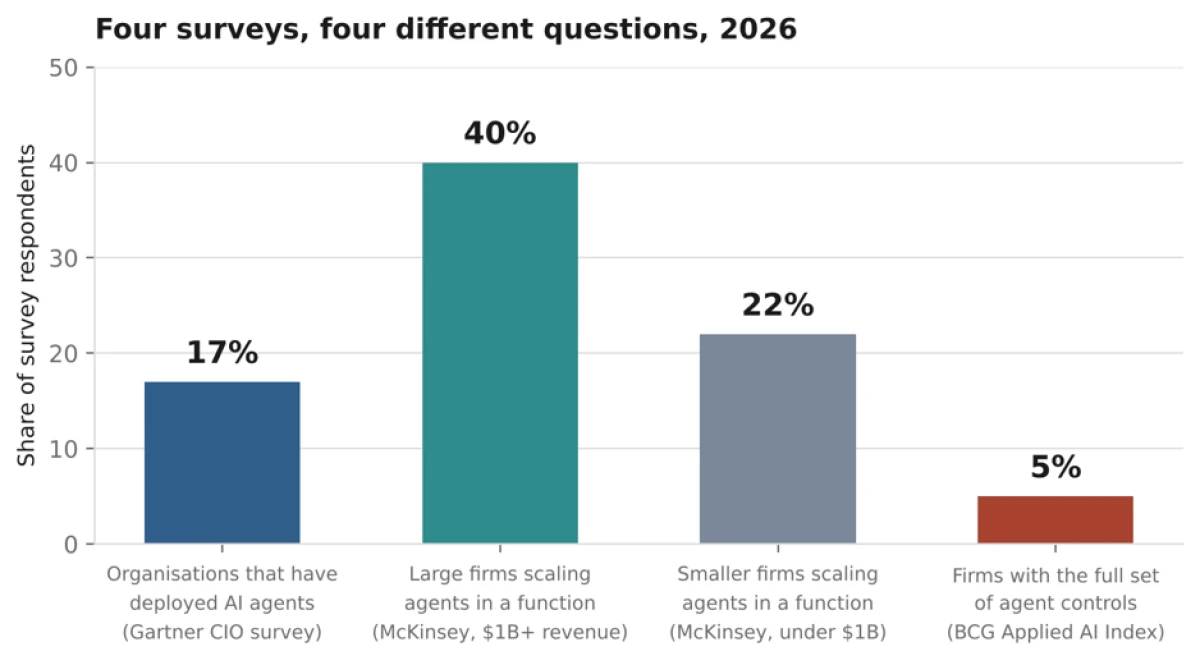
Figure 3. Four widely quoted figures. Each bar answers a different question, so the percentages should never be used interchangeably.
| Measure | Figure | Source and what was asked |
|---|---|---|
| Organisations that have deployed AI agents | 17% | Gartner 2026 CIO and Technology Executive Survey, with more than 60 percent expecting deployment within two years, which Gartner called the most aggressive adoption curve among the emerging technologies it measured |
| Large organisations scaling agents in at least one function | 40% | McKinsey Global Survey on the state of AI, August 2026, respondents at organisations above $1 billion in revenue, up from 27 percent a year earlier |
| Smaller organisations scaling agents | 22% | Same survey, organisations below $1 billion in revenue, essentially unchanged on the previous year |
| Organisations scaling agents in any single business function | No more than 10% | McKinsey, November 2025 edition, which is the figure that punctures most adoption claims |
| Companies with the full set of controls for autonomous agents | 5% | BCG Applied AI Index 2026, survey of 1,330 senior leaders, against 42 percent expecting to grant agents real decision-making authority by 2030 |
| Enterprise applications carrying task-specific agents | 40% forecast | Gartner projection for the end of 2026, against under 5 percent in 2025, which measures what vendors ship rather than what buyers build |
| Agentic AI projects forecast to be cancelled | Over 40% | Gartner, June 2025, by the end of 2027, attributed to escalating costs and unclear business value, with inadequate risk controls given as the third reason |
Table 6. Adoption figures with the question each one answers. A claim such as 40 percent of companies use agents misstates every row in this table.
The pattern underneath is a two-track market. Experimentation is close to universal and scaled production remains narrow, with large enterprises pulling away from smaller ones. McKinsey's 2026 survey found 80 percent of respondents reporting personal productivity gains while only 37 percent attributed any earnings impact to AI, and about 6 percent qualified as high performers on its definition. Individual benefit is easy. Enterprise benefit requires the surrounding process to change.
MIT's NANDA initiative reported a sharper version of the same finding. Across more than 300 public deployments, 150 leader interviews and a survey of 350 employees, roughly 95 percent of generative AI pilots produced no measurable effect on profit and loss. The study attributed the gap to a learning problem rather than model quality, and found that purchased solutions built around a specific workflow succeeded considerably more often than general-purpose internal builds.
Agent washing, and how to spot it
Gartner's June 2025 analysis gave the mislabelling problem a name. Vendors were rebranding chatbots and existing RPA tooling as agentic without adding the capability the word implies. Of thousands of vendors making agentic claims, the firm judged around 130 to be delivering genuine agentic capability. Its January 2025 poll of 3,412 attendees found 19 percent of organisations making significant agentic investment and 31 percent still undecided.
Five questions cut through most of it, and each has a verifiable answer rather than a rhetorical one.
- Show a run where the system took a path that does not exist in the configuration. If every path can be found in a settings screen, the product is a workflow engine.
- Name the tools it can call and the write permissions attached to each. Read-only access means the system recommends rather than acts.
- Describe what happens on an unrecognised input. Escalation is an acceptable answer. Silent failure is not.
- State the trajectory success rate across complete runs on the buyer's own data, not per-step accuracy on a benchmark.
- Produce the audit log for a single completed run, showing each decision, each tool call, each retry and each escalation.
Which work suits this approach
Fit is decided by four properties of the work itself: how much variation it contains, how reversible its actions are, how clearly success can be measured, and how long the chain of steps runs. Work that varies, reverses cleanly, finishes in a handful of steps and arrives in enough volume is where these systems earn their cost.
| Type of work | Strong fit | Poor fit |
|---|---|---|
| Variation | Each case differs in ways rules cannot enumerate | Every case is identical and already automated |
| Reversibility | A wrong action can be undone or corrected cheaply | Actions are irreversible, such as a payment release |
| Measurability | Success is checkable by the system itself | Quality is subjective and only a person can judge it |
| Chain length | The goal is reached in a few dependent steps | Dozens of steps must all succeed in sequence |
| Data available | Context sits in systems the agent can query | Key context lives in someone's head |
| Volume | High enough that the engineering amortises | A handful of cases a month |
| Regulatory load | Decisions tolerate probabilistic behaviour | Every decision must be identical and defensible |
Table 7. A fit assessment. Scoring a candidate process against all seven rows before building prevents the most expensive category of agentic project failure.
Exception handling is the strongest candidate across most organisations, for a structural reason. Rule-based automation already clears the clean cases, so what reaches a human queue is precisely the variable, judgement-bearing work that scripts cannot absorb. In accounts payable, matched invoices flow through untouched and the backlog is entirely mismatches, contract amendments, disputed quantities and short deliveries.
Deployments with published numbers
Public case studies tend to be company claims rather than audited results, and a good guide says so. The figures below are what the organisations themselves reported.
| Organisation | What was deployed | Reported result | The honest caveat |
|---|---|---|---|
| Klarna | Customer service assistant handling chat across 35 languages | 2.3 million conversations in the first month, around two-thirds of chats, resolution time from 11 minutes to under 2 | In May 2025 the chief executive said the cost focus had gone too far and quality had suffered, and the company resumed recruiting human agents |
| Lyft | Customer care assistant built on Claude through Amazon Bedrock | 87 percent reduction in average resolution time | Company-reported, with no published breakdown of case mix |
| Software engineering teams broadly | Coding agents working across repositories | About two in ten organisations scaling them, rising to 31 percent at large enterprises | The most mature category, helped by cheap verification through tests |
Table 8. Reported deployments. The Klarna reversal is the most instructive entry, because the initial numbers were real and the conclusion drawn from them was premature.
Coding is the furthest-advanced category for a reason worth generalising. Tests provide an automatic verifier and failure is visible within seconds, so a wrong answer costs a rerun rather than a customer. Any process with a comparable verifier is a better first candidate than one where errors surface weeks later.
The risks that arrive with autonomy
A language model that produces a wrong sentence has caused an inconvenience. A language model wired to a payments API that produces a wrong sentence has moved money. The security profile changes the moment software is granted hands.
The OWASP GenAI Security Project published its Top 10 for Agentic Applications in December 2025, numbered ASI01 through ASI10, precisely because the earlier list for language model applications assumed a single call with a single response. Four entries define the shape of the problem.
| Risk | What it looks like | Containment |
|---|---|---|
| Agent goal hijack (ASI01) | Instructions hidden in a document, email or web page redirect the agent's entire plan rather than one response | Treat every retrieved input as untrusted, and separate instruction channels from data channels |
| Tool misuse (ASI02) | The agent calls legitimate tools with dangerous parameters, which looks identical to authorised activity in the logs | Scope each tool narrowly and issue short-lived credentials, then log the parameters rather than only the tool names |
| Memory and context poisoning (ASI06) | Incremental false context accumulates until the agent believes it holds authority it never had | Expire memory, validate what gets written to it, and re-verify authority limits at each use |
| Human trust exploitation (ASI09) | The agent presents a manipulated request convincingly and a person approves it, making the compromise invisible in the audit trail | Show approvers the underlying evidence, not the agent's summary of it |
Table 9. Four of the ten OWASP agentic risk categories. The common thread is that agents amplify weaknesses that were survivable at the single-call level.
A documented example makes the amplification concrete. EchoLeak, tracked as CVE-2025-32711 and scored 9.3 by Microsoft, was a zero-click indirect prompt injection in Microsoft 365 Copilot. No user action was required for the attack to reach the model's reasoning.
The practical mitigation is unglamorous. High-impact and irreversible actions pass through a human signature or a policy gate. Everything else runs inside a permission boundary narrow enough that the worst outcome of a confused agent is a wasted run.
Controls are what decide the return
The governance gap is the most quantified finding in recent research, and it points in an unexpected direction. Controls are not the tax paid on autonomy. They are what makes autonomy pay.
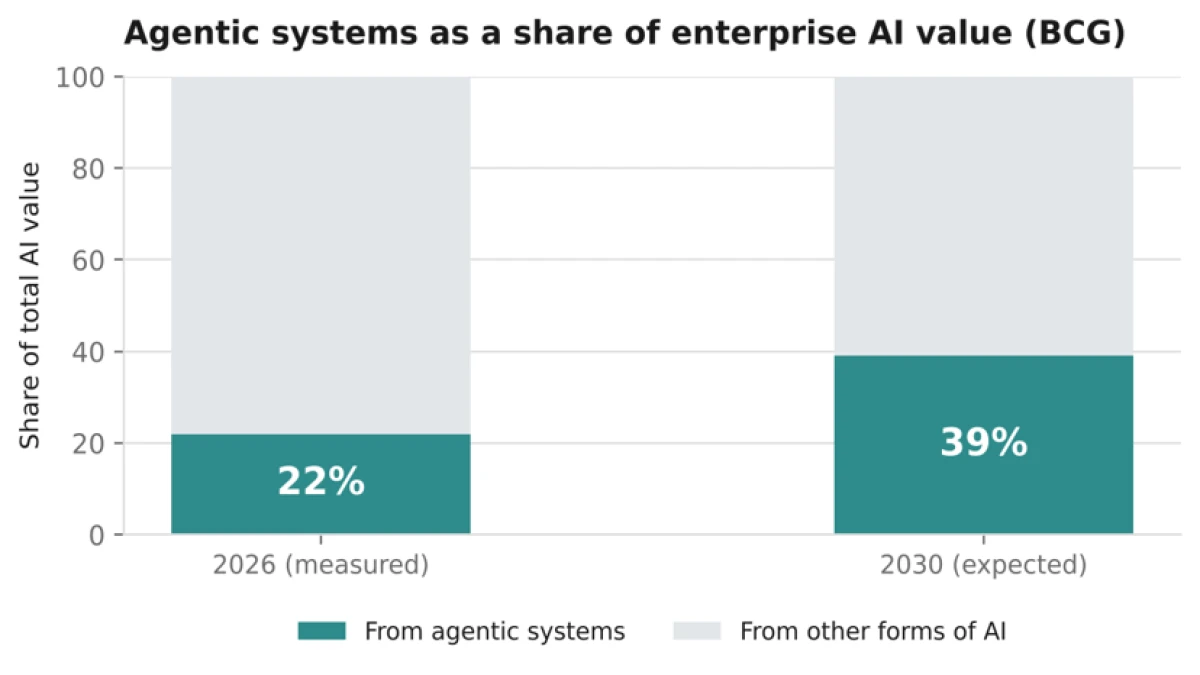
Figure 4. Agentic systems accounted for about 22 percent of enterprise AI value in BCG's 2026 sample, with a projection toward 39 percent by 2030.
BCG's 2026 Applied AI Index, drawn from 1,330 senior leaders across more than twenty sectors, found that 42 percent of companies expect to grant agents genuine decision-making authority by 2030 while 5 percent currently hold the full set of controls needed to do so safely. Organisations with all six identified controls generated roughly three times the agentic value of those with only one.
The six cover memory and data access management, oversight of how tasks are handed to agents, testing with shut-off and rollback gates, interface controls, leadership instructions written for managing agents, and ongoing security control as operations change. Measurement sits alongside them: 95 percent of the companies BCG classified as leaders track AI through profit and loss or defined business metrics, and those measuring directly in the profit and loss realised roughly three times the value of firms that did not formally measure at all.
McKinsey's trust research found the same obstacle from the opposite side. Nearly two-thirds of respondents named security and risk as the top barrier to scaling agentic AI, ahead of regulatory uncertainty, while average responsible AI maturity sat at 2.3 out of 5 and only about a third reported governance maturity at level three or above.
A sequence that survives contact with production
The order below reflects what separated the deployments that scaled from the ones that were cancelled. It is deliberately slow at the start.
1. Pick a process where a human queue already exists. The queue is proof that rules could not absorb the work, and its length is the baseline for measuring improvement.
2. Count the dependent steps before writing anything. If the honest count exceeds roughly ten, split the process into checkpointed segments rather than building one long chain.
3. Define the verifier first. A system that cannot check its own output has no feedback loop, and without a feedback loop the fourth component of the anatomy is missing.
4. Grant the narrowest tool permissions that allow the work to finish, and treat every widening as a separate decision with a named owner.
5. Run alongside the human process rather than in place of it, comparing outputs on the same cases until the trajectory success rate is known on real data.
6. Instrument every step before scaling, because a run that cannot be replayed cannot be debugged and cannot be defended to an auditor.
7. Put the irreversible actions behind a human signature, and show the approver the evidence rather than the agent's summary of the evidence.
8. Measure against the original queue rather than against the demo, using cost per resolved case and the share of cases that never reached a person.

With experience writing 500+ pieces of content across different formats, I focus on making technology and cybersecurity topics clear, informative, and accessible. At **TechJox**, I cover tech news, cybersecurity trends, digital safety, and practical guides that help readers stay informed and make better decisions. My approach combines research, accuracy, and simple storytelling to turn complex information into useful, engaging, and easy-to-understand content.
Discussion (0)
You need a free TechJox account to join the discussion and report scams you spot.