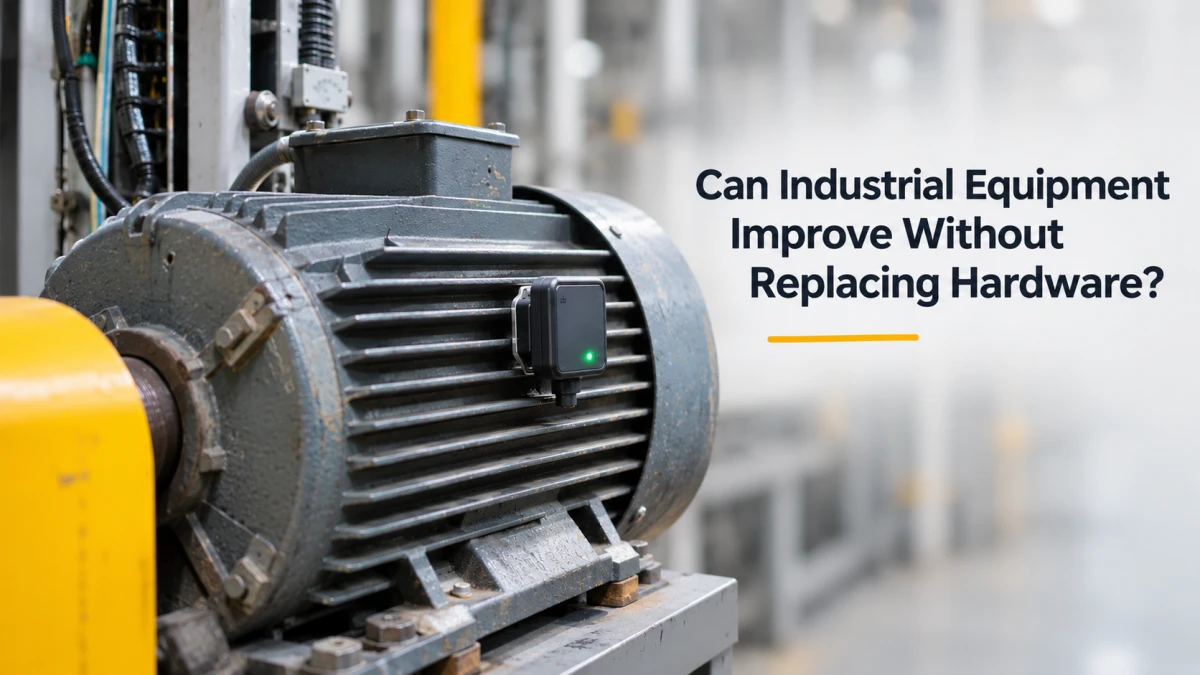
Most factories run on machines bought for a different decade. The castings and gearboxes are often still sound. What has aged is the control logic, the data the machine produces and the way it gets maintained. That gap explains why plant managers keep asking whether they can improve industrial equipment without replacing hardware. The evidence says yes, within limits that are easy to define once the losses are measured.
Short answer: Yes. Most industrial equipment can run longer between failures and use less energy after changes to its control software and maintenance routine, with the core machine untouched. Low-cost add-ons such as clamp-on sensors or variable frequency drives extend the gains. Replacement only wins when the mechanical base is worn out or physically unable to hit the required spec.
Why Older Equipment Underperforms
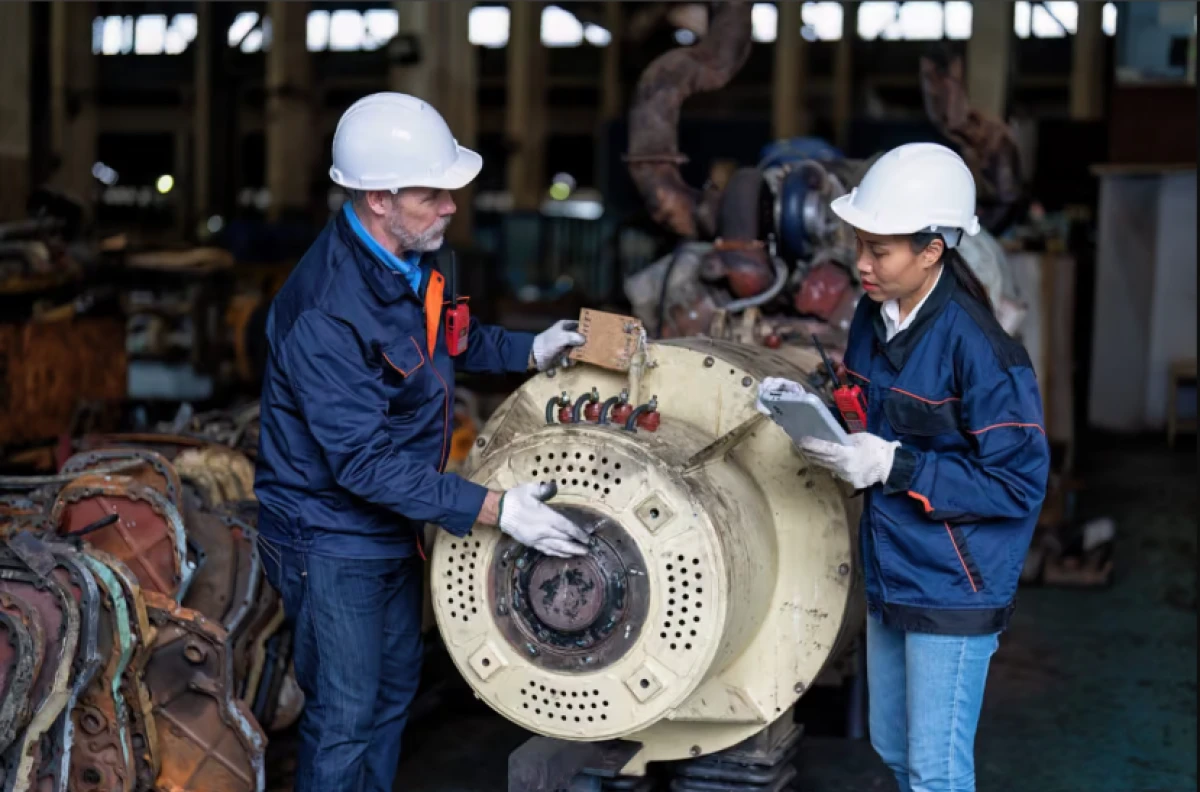
The machine itself is rarely the main problem. Lost output usually hides in short stops nobody logs and in maintenance that happens after a breakdown rather than before one.
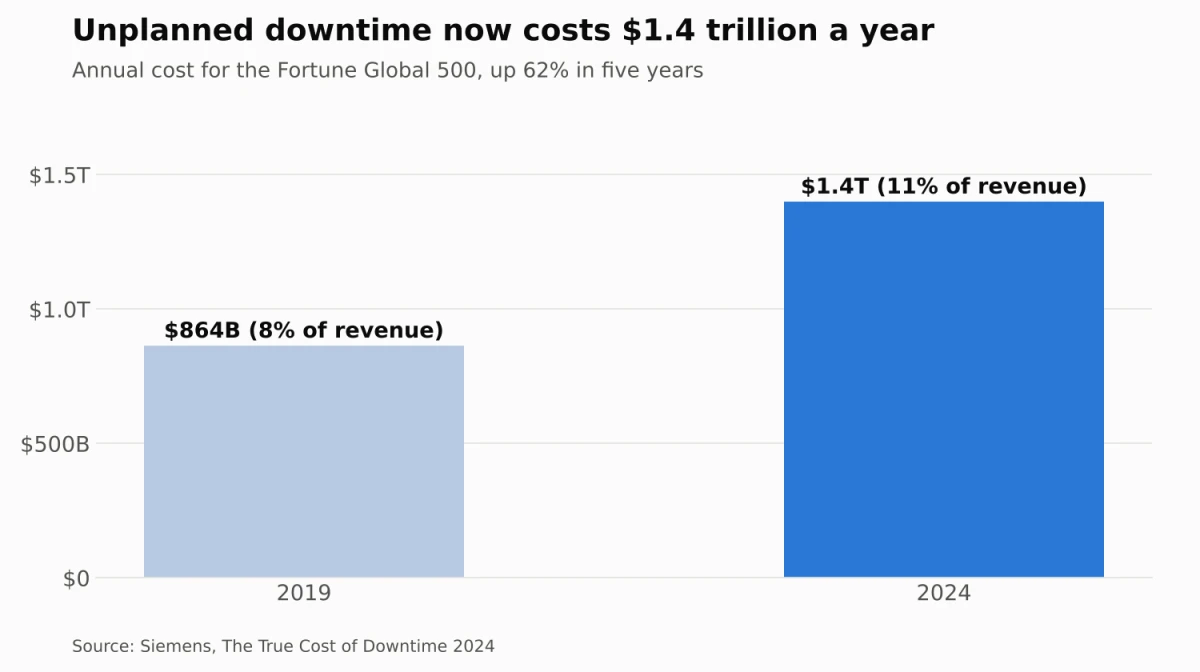
The cost of that hidden loss keeps climbing. Siemens' True Cost of Downtime 2024 report puts unplanned downtime at $1.4 trillion a year for the world's 500 largest companies. That equals 11% of their revenue, up from $864 billion (8%) in 2019. In automotive plants, one idle hour now costs about $2.3 million.
Meanwhile, the installed base is huge and still working. A Siemens and Manufacturers Alliance study cites NIST figures valuing legacy US manufacturing equipment at about $2.65 trillion, most of it functional. ABI Research found that 51% of brownfield sites remain at the early automation stage.
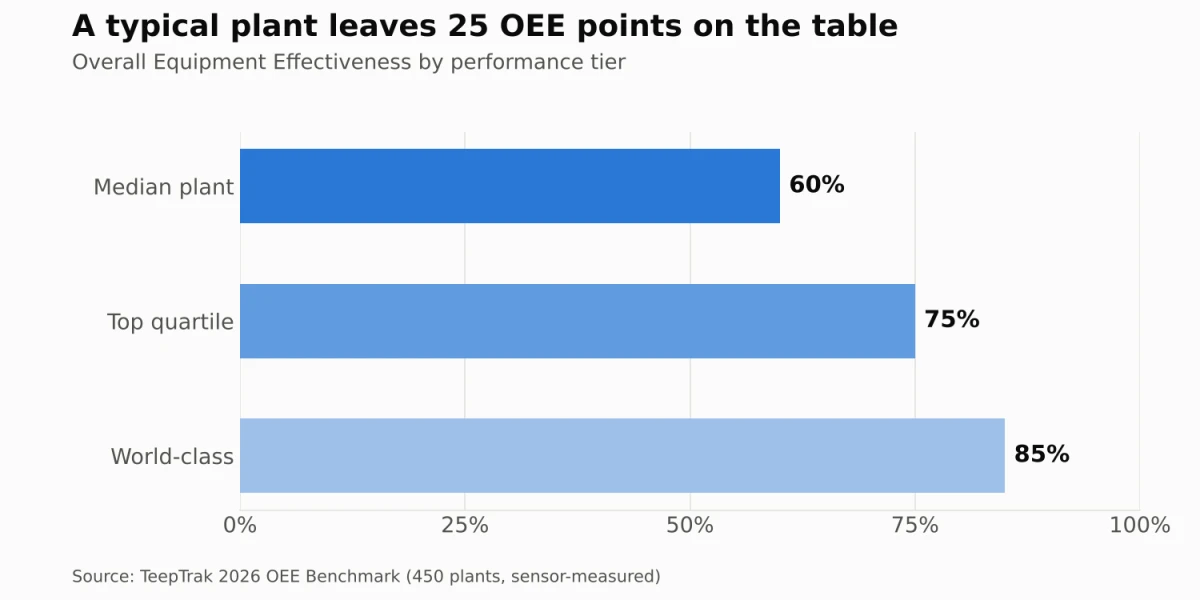
Overall Equipment Effectiveness (OEE) shows the size of the opportunity. Benchmark data from 450 plants puts median OEE near 60%, against roughly 85% for world-class discrete manufacturing (TeepTrak OEE Benchmark 2026). The same data shows manual shift logs overstate OEE by 8 to 15 points, because short stops never get written down. Much of that 25-point gap comes from losses that existing machines can recover.
The Upgrade Ladder: Four Levels of Equipment Improvement
The clearest way to plan is to climb a ladder, starting with the cheapest rung and moving up only when the data justifies it. Each level keeps more of the original machine than the one above it.
| Level | What changes | Core machine replaced? | Relative cost | Production impact |
|---|---|---|---|---|
| 0. Configure | Control tuning, PLC logic, setpoints, firmware, maintenance method | No | Lowest (mostly engineering hours) | Minimal; often done between shifts |
| 1. Bolt on | Clamp-on sensors, edge gateways, protocol converters, variable frequency drives | No | Low | Hours per machine |
| 2. Retrofit | New controller, servo drives, HMI, wiring | No, the mechanics stay | Moderate (CNC control retrofits run 25% to 40% of a new machine) | Planned shutdown |
| 3. Replace | Entire machine | Yes | Highest | Installation plus retraining |
Level 0: Improvements That Need No New Hardware
Retune control loops and clean up PLC logic
Many PID loops still run on commissioning defaults, or were detuned years ago to stop a problem nobody remembers. An oscillating loop wastes energy and wears out valves and actuators faster. Retuning loops and tightening sequence timing can cut cycle time with nothing more than a laptop and a planned test window.
Use the data the controller already holds
Most PLCs already count cycles and log fault codes. Reading that data through an existing Ethernet port with a software driver for OPC UA or Modbus TCP turns a blind machine into a measured one. The first win is usually a ranked list of micro-stops that never appeared in shift reports.
Fix compressed air before buying a new compressor
A Compressed Air Challenge fact sheet notes that poorly maintained systems can lose 20% to 30% of compressor output to leaks, while a well-maintained system stays under 10%. The sourcebook behind it was developed with the US Department of Energy. Pressure matters too: compressor power rises about 1% for every 2 psi of extra discharge pressure (Compressed Air Best Practices). Dropping header pressure to what the end users actually need costs nothing.
Switch from calendar maintenance to condition-based maintenance
Replacing parts on a fixed schedule throws away good components and still misses failures that strike between intervals. Using run hours and fault history from the controller to trigger work orders is a process change, not a purchase.
Level 1: Bolt-On Upgrades That Leave the Machine Intact
Add sensors for predictive maintenance
Retrofit sensors for vibration, temperature, motor current and pressure cost hundreds of dollars, not thousands (IndustryWeek). Optical sensors can even read a machine's stack lights, which brings equipment with no usable controller into an IIoT system.
The payoff is well documented. McKinsey reports that predictive maintenance typically cuts machine downtime by 30% to 50% and extends machine life by 20% to 40%. Deloitte cites 10% to 20% higher uptime and 5% to 10% lower maintenance cost. It also reports 20% to 50% less time spent planning maintenance.
Those figures describe mature programs. A first pilot with noisy alarm thresholds will land well below them, so start on two to four critical assets and tune alerts before scaling.
Fit variable frequency drives to pumps and fans
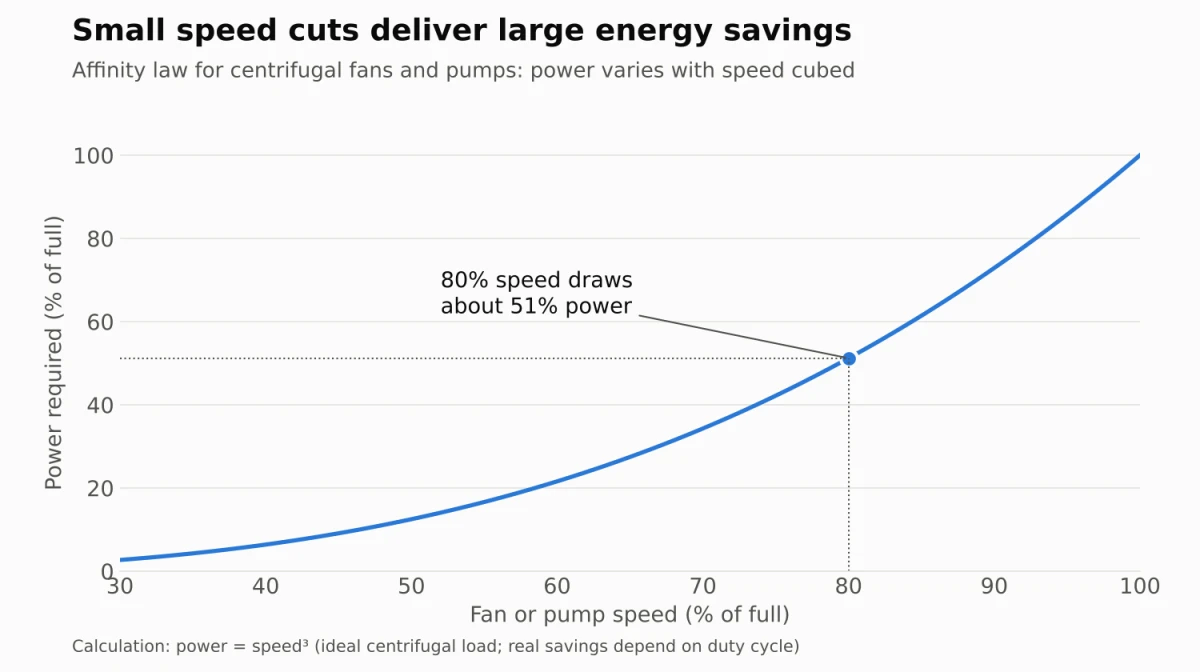
Electric motor systems consume 72% of industrial electricity, according to the IEA 4E Electric Motor Systems Platform. Many of those motors run flat out while a valve or damper throttles the flow, which burns power for no output.
A variable frequency drive (VFD) slows the motor instead. Under the fan and pump affinity laws, power falls with the cube of speed, so a fan at 80% speed draws about 51% of full power. Savings depend on the duty cycle, which the DOE's adjustable speed drive tip sheet explains how to calculate before buying.
Level 2: Retrofit the Controls, Keep the Mechanics
Replace obsolete controllers and drives
When spare parts for a control system disappear, a control retrofit is often the smartest move. Machine tool remanufacturers quoted by Cutting Tool Engineering put a CNC control retrofit at 25% to 40% of the cost of a new machine. In one aerospace job described there, faster rapid rates after a control upgrade raised productivity by 40%.
The same source offers a blunt warning: "A new control does not equal a new machine." Worn ways, ballscrews or loose spindles should be fixed during the retrofit, or the new control will simply expose old mechanical faults faster.
Plan for cybersecurity before connecting anything
Many legacy HMIs still run on Windows XP, which lost support in 2014, or Windows 7, which lost it in 2020. Connecting them to a plant network without planning invites risk. The safer pattern starts with segmenting OT from IT networks and using passive discovery, since active scans can crash old PLCs. Data should then be pulled read-only, so control logic is never touched.
When Replacement Is the Right Call
Retrofitting is not always cheaper over the machine's remaining life. The table below sums up the signals that should push a decision one way or the other.
| Situation | Better choice | Why |
|---|---|---|
| Sound mechanics, obsolete controls | Retrofit | The expensive part of the machine is still good |
| Worn mechanics plus obsolete controls | Compare against new | Rebuild plus retrofit can approach the price of a new machine |
| Low-cost commodity machine | Replace | Retrofit cost can match or exceed the price of a new unit |
| Required tolerance or capacity is beyond the machine's design | Replace | No software update changes physical rigidity or travel |
| Current safety standards cannot be met with added guarding | Replace | Compliance outweighs savings |
| Spare parts scarce, modern drop-in equivalents available | Retrofit | Obsolescence is solved without losing the machine |
One integrator quoted by Cutting Tool Engineering gives a useful rule of thumb: with control retrofit packages starting near $75,000, any machine that can be bought new for under $125,000 is usually better replaced.
A 90-Day Plan to Start Improving Existing Equipment
- Weeks 1 to 2: Measure the bottleneck. Capture OEE automatically on the one machine that limits plant output, not on the whole floor.
- Weeks 3 to 6: Work Level 0. Retune loops, fix air leaks, lower pressure setpoints and rank micro-stops from controller data.
- Weeks 7 to 10: Add Level 1 on critical assets. Fit vibration and current sensors to two to four machines whose failure stops the line, and size VFDs for throttled pumps and fans.
- Weeks 11 to 12: Compare against the baseline. Calculate recovered hours and energy in money terms.
That measured baseline is what turns the next upgrade into a budget approval. A documented gain on the bottleneck is far easier to fund than a vendor projection, and it shows exactly which rung of the ladder the plant needs next.
Frequently Asked Questions
What is retrofitting in industrial equipment?
Retrofitting means adding new technology to an existing machine instead of replacing it. Typical retrofits include sensors, edge gateways, variable frequency drives or a new control system, while the frame and spindle stay in place. The goal is modern performance and data visibility at a fraction of the cost of new equipment.
Is retrofitting cheaper than buying new machinery?
Usually, yes. A CNC control retrofit typically costs 25% to 40% of a comparable new machine, and sensor-based upgrades cost far less. The exception is low-cost commodity equipment, where the retrofit price can match a new unit. Mechanical condition decides the case, because a new control cannot fix worn ways or a damaged spindle.
Can old machines connect to IIoT without a PLC?
Yes. Machines with no usable controller can still report data through clamp-on current sensors, vibration sensors, temperature probes or optical sensors that read stack lights. An edge gateway then converts those signals into standard protocols such as MQTT or OPC UA, so the machine appears in the same dashboard as modern equipment.
How long does an industrial equipment retrofit take?
It depends on the level. Clamp-on sensors and gateways usually install in hours per machine and rarely need a shutdown, because they do not touch the control circuit. A full control retrofit requires a planned shutdown for rewiring, testing, commissioning and operator training, so most plants schedule it into an annual maintenance window.
Does predictive maintenance work on legacy equipment?
Yes, and older machines often benefit most because they fail more often. Retrofit vibration and temperature sensors feed failure patterns to software that flags faults early. McKinsey reports downtime reductions of 30% to 50% in mature programs, though first pilots should expect smaller gains while alert thresholds are tuned.
Do variable frequency drives save energy on every motor?
No. VFDs save the most on variable-torque loads such as fans and pumps that are throttled by valves or dampers. A motor that already runs at full load all day gains little, and a poorly applied drive can even raise energy use. Check the duty cycle before buying one.

Ethan Mitchell is a technology writer at TechJox, specializing in artificial intelligence, cybersecurity, SaaS platforms, software applications, and digital automation. His writing covers AI tools, data privacy, emerging technologies, and software reviews, with a focus on practical insights, clear explanations, and helping readers make informed technology decisions.
Discussion (0)
You need a free TechJox account to join the discussion and report scams you spot.