Three AI systems handle the same inbox. The first answers a customer's question about shipping times. The second checks that customer's order record and processes a return that falls inside policy. The third reads six months of complaints, traces most of the returns back to a single product description and recommends rewriting it.
All three get called AI agents. What separates them has nothing to do with how fluent the language sounds and everything to do with the way each one takes in information and converts it into an action. Classical AI textbooks describe five agent types built around exactly that question. Those five still explain the decision logic underneath modern systems, though they no longer describe the whole picture.
What makes an AI system an agent rather than just a chatbot?
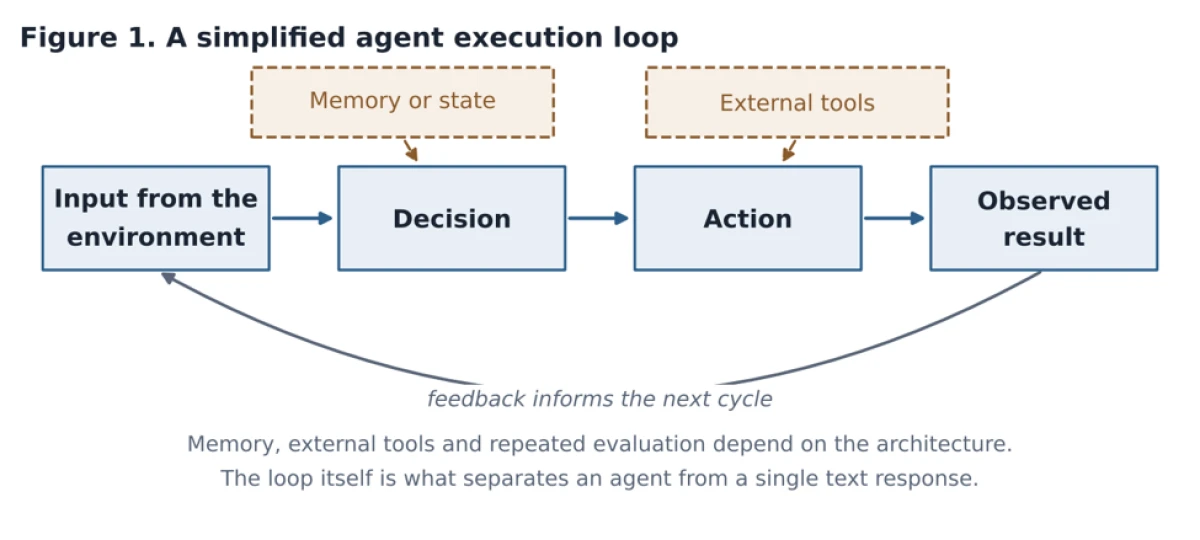
A chatbot receives text and returns text. An agent receives information about a situation, selects an action, performs it, then observes the result and decides whether anything further is needed. The loop is the distinction.
Two systems answer the question “where is my order?”. One explains the shipping policy accurately. The other queries the order database and reports that the parcel has stalled at a sorting facility, with a revised date. Only the second changed anything outside its own text output.
Three assumptions attached to the word agent do not hold up. An agent does not require a large language model, since a rule-driven email router and a logistics route planner both qualify under the classical definition. It does not require persistent memory, because many agents act on current observations alone. And it does not require unlimited freedom to act, as most production systems run inside tight permission boundaries.
The five traditional AI agent types and how they make decisions
The five traditional types are simple reflex agents, model-based reflex agents, goal-based agents, utility-based agents and learning agents. The sequence, set out in Russell and Norvig's Artificial Intelligence: A Modern Approach, describes increasing sophistication in how an agent decides. It does not describe increasing intelligence.
1. Simple reflex agents: responding to what happens right now
A simple reflex agent maps the current observation to an action through condition-action rules. No history is consulted. An email filtering system works this way when it routes messages by sender domain or by a flagged phrase, which keeps the rule set auditable and the behavior predictable.
The weakness shows at the edges. When an input matches no rule, the agent applies a catch-all or does nothing, so a message from an unknown sender with an unfamiliar attachment gets whichever default exists.
2. Model-based reflex agents: remembering what the environment looked like before
A model-based reflex agent keeps an internal representation of its environment and consults it before acting. A scanner reporting that bin 47 is empty cannot, on that observation alone, distinguish stock that was sold from stock that was moved. The internal model, holding recent movements, resolves the ambiguity.
Storing state is not learning. The model updates what the agent believes right now, while the rules converting those beliefs into actions stay as written. A system can track thousands of variables and still repeat the same mistake.
3. Goal-based agents: working out which actions lead to a desired result
A goal-based agent holds a representation of a desired end state and selects actions by asking which ones move it closer, which introduces planning. An SEO research agent told to find content opportunities pulls competitor pages, retrieves keyword data, checks both against what the site already publishes and compiles the gaps, though none of those steps was specified. The goal implied them.
Completion is the harder half. “Produce a useful report” cannot be checked, while “cover every keyword cluster above a set search volume where the site has no ranking page” can be. These agents fail more often on an uncheckable objective than on weak planning.
4. Utility-based agents: choosing the most valuable outcome, not just any outcome
Goals are binary, reached or not reached. Utility turns that into a scale, scoring the available options against weighted criteria. A delivery scheduler weighs routes against delivery time, fuel consumption, driver hours and vehicle capacity. Several routes satisfy the goal, and the utility function decides which one is preferred.
Conflict between criteria is the normal case. Whoever sets the weights is making a business decision and encoding it as arithmetic, which is why a system producing results nobody wants usually has a weighting problem rather than an algorithm problem.
5. Learning agents: changing future decisions based on experience
A learning agent changes its own decision-making in response to feedback. The classical description divides it into an element that acts, a critic that judges the outcome, a learning element that applies improvements and a problem generator that suggests exploration. A fraud detection system fits when confirmed chargebacks feed back into the model scoring future transactions.
Several things get called learning, and only one is. Retrieving a stored fact is recall. Adjusting partway through a task is adaptation inside one episode. Learning means a durable update to a model or policy that survives the task, and it works as a modifier rather than a category: a goal-based agent with a feedback loop is still one.
Give all five agents the same task: what changes?
Most explanations use a different example for each agent type, which hides the thing worth seeing. One request, handed to five architectures, produces five different reasoning processes.
The scenario: a customer requests a return eleven days after the 30-day window closed. The order was large, the customer has bought regularly for three years, the product carries a documented defect rate and the published policy states the window firmly.
Table 1. One return request, five decision architectures
| Agent type | What it considers | Likely action |
|---|---|---|
| Simple reflex | The published return deadline and nothing else | Rejects the request as outside the window |
| Model-based reflex | The deadline alongside the purchase record and earlier interactions | Applies the exception rule recorded for long-standing accounts |
| Goal-based | The objective of closing the complaint within policy | Searches for a resolution the policy already permits |
| Utility-based | Refund cost weighed against retention value and defect history | Prices store credit against a replacement and picks the better score |
| Learning | Outcomes of similar cases resolved previously | Applies the pattern that held comparable customers before |
These outcomes are illustrative rather than guaranteed behavior, and a badly configured utility-based agent will produce worse decisions than a well-written rule.
Architecture is a question about the task rather than a capability ranking. A return window with no exceptions is served well by a simple rule. A policy with documented exceptions needs state. A policy where the answer depends on balancing refund cost against retention value needs a utility function, because no rule could encode a decision that has no single correct answer.
How modern AI agents differ from the textbook five
A coding agent that reads a repository, plans a change, edits files and runs tests is goal-based in the way it plans and utility-based when it weighs a quick fix against a correct one. It is also model-based, since it holds an understanding of the codebase between steps. Listing those as separate agent types would describe one system three times.
The traditional taxonomy answers a single question: how does this system decide? Deployment raises three more. What is the agent responsible for? How much can it do without being asked? Does it work alone?
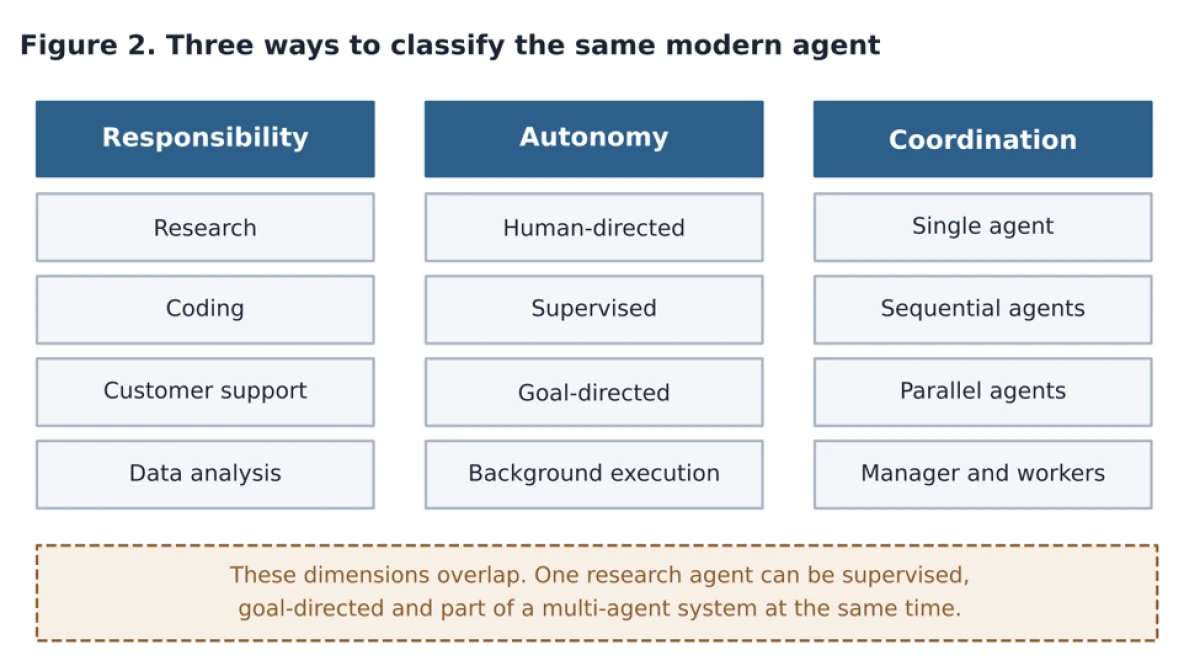
These dimensions are independent of each other. A customer support agent and a research agent can share an identical decision architecture while differing completely in permissions and oversight.
Seven task-oriented AI agents in use today
The categories below describe responsibility rather than decision architecture. They do not extend the numbering of the classical five, and one product often belongs to several of them at once.
Research agents: gathering evidence before producing an answer
A research agent finds sources, extracts the relevant content, compares claims across documents and produces a referenced answer. Competitor research is representative: it collects pricing pages, feature documentation, review summaries and positioning claims, then reports where a new product would sit.
Source quality varies, and a confident summary of a weak source reads exactly like a confident summary of a strong one. Fabricated citations remain common enough that verification belongs inside the workflow.
Coding agents: making changes across an entire codebase
A coding agent operates on a repository rather than a snippet. It navigates the file tree, edits across multiple files, runs the test suite and reads the failures it caused.
The gap between suggesting code and completing a task is the whole distinction. Given an instruction such as fixing a failing checkout test, the agent locates the cause and verifies its own fix, where an autocomplete tool would propose a few lines and leave the decision to a developer. It also owns the consequences of changing the wrong thing, which is why these agents run against version control.
Customer support agents: resolving requests instead of repeating policy documents
A support agent with database access resolves a request. A chatbot without it describes the policy governing the request. Order history and account records turn an explanation into a resolution.
Permissions define the risk. An agent that can issue refunds can issue incorrect ones at volume, with nobody noticing until the finance reconciliation, which is why deployments bound it with transaction limits and escalation rules.
Workflow agents: handling exceptions that fixed automation cannot predict
Fixed automation handles the cases somebody anticipated. A workflow agent handles the remainder. A rules-based invoice pipeline reads structured documents from known suppliers and stalls on a PDF with an unfamiliar layout, where an agent interprets that document and routes the extracted fields onward. CRM lead qualification follows the same shape.
If the path through the system is identical every time and only the text inside one step varies, that is automation with a language model inside it rather than an agentic workflow.
Computer-use agents: operating websites and applications through their interfaces
Some systems have no API. A computer-use agent operates the interface the way a person does, reading the screen and acting on it with clicks and keystrokes, which reaches legacy software and internal portals never built for programmatic access.
It is also the most fragile category here. A relocated button or a new consent dialog breaks a flow that worked yesterday, because the agent reads a rendering rather than a contract.
Data analysis agents: deciding which information to investigate next
A data analysis agent chooses what to look at next. Given a question about a sales decline, it queries the warehouse, notices the drop concentrates in one region, segments further and tests whether the pattern is seasonal.
Dirty data produces clean-looking wrong answers, and a correlation surfaced without a statistical check gets stated as fluently as a verified finding. These agents are most reliable when they return the query alongside the conclusion.
Monitoring agents: watching for changes without waiting for a new prompt
Every other agent here waits for a prompt. A monitoring agent runs on a trigger, either a schedule or a threshold breach, which covers cybersecurity monitoring and inventory tracking alike.
A conventional alert fires when CPU passes 90 percent. A monitoring agent fires, identifies the responsible process, correlates the spike with a recent deployment and escalates with that context attached. The investigation between trigger and notification is the part a threshold alert leaves to whoever is on call.
How much independence does an AI agent actually have?
Autonomy describes how much an agent does between human touchpoints. It is separate from what the agent is for, and it is not a measure of quality.
Human-directed agents that wait for instructions
The agent acts on an explicit request and returns control when that task ends. Every action traces back to something a person asked for, which suits work where accountability outweighs throughput. Nothing happens in the background.
Supervised agents that stop before consequential decisions
The agent plans and executes freely until it reaches an action on a defined list, then pauses for approval. Spending above a threshold and irreversible changes are the usual checkpoints. Supervision works only while it stays selective, since routine approval prompts train reviewers to stop reading them.
Agents that continue working toward a delegated goal
The agent receives an objective and works until a stopping condition is met. Those conditions matter more than the planning does, since a step budget, a time limit, a cost ceiling and a completion test are what stop an agent looping on an unachievable task.
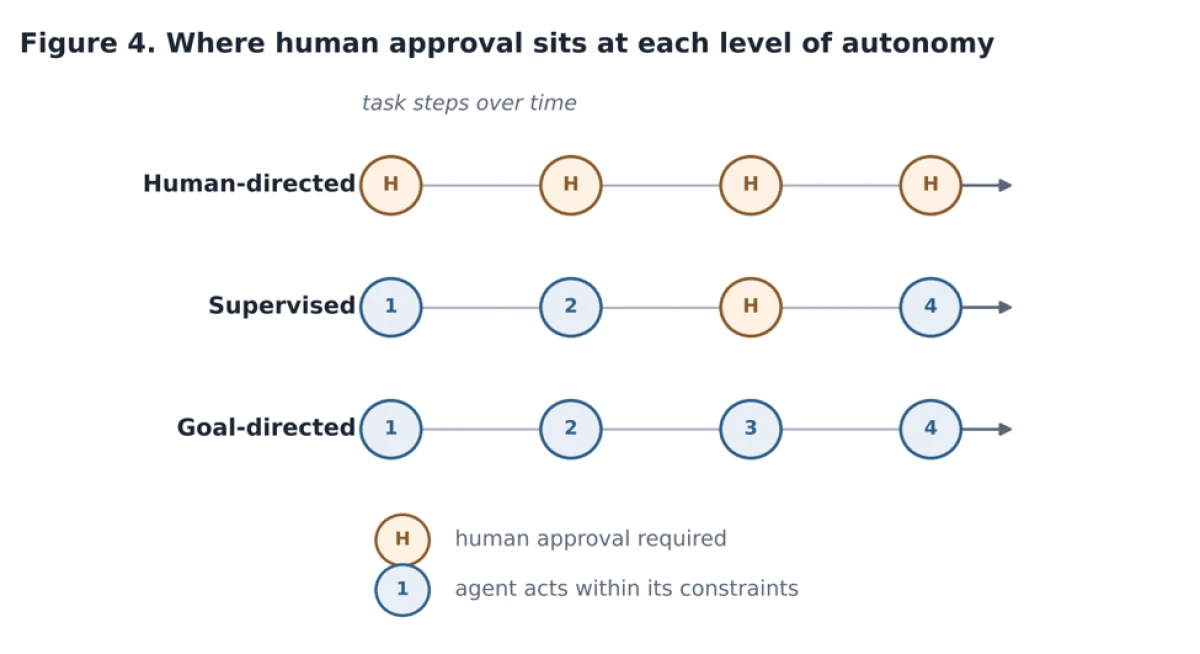
Table 2. Who holds control at each level of autonomy
| Level of autonomy | Who initiates the task? | Who controls subsequent actions? |
|---|---|---|
| Human-directed | The user | The user, who approves each action |
| Supervised | The user or a system trigger | The agent, inside approval boundaries |
| Goal-directed autonomous | The user or a system trigger | The agent, inside defined constraints |
Greater autonomy does not improve decision quality. It removes the checkpoints at which poor decisions would have been caught.
When one AI agent becomes an entire team
One agent with multiple tools
A single agent holding a search tool and a document reader covers most work that looks as though it needs a team, with context in one place and one execution trace for the whole run. Adding a tool is cheap. Adding an agent is not.
Specialized agents working on different parts of a task
Content production is the standard illustration. A research agent gathers sources. A writing agent drafts from what was found, and an editorial agent checks those claims back against the sources. The pattern earns its complexity when sub-tasks need genuinely different instructions or can run in parallel.
Why adding more agents can make a system worse
Coordination is not free. Context gets duplicated across agents, and results need summarizing at every handoff. Anthropic's engineering guidance reports multi-agent implementations consuming three to ten times the tokens of single-agent approaches on equivalent tasks, after teams spent months on elaborate architectures that better prompting on a single agent went on to match.
Token cost is the measurable part. The harder costs are duplicated work when the division of labor is unclear and failures that resist diagnosis because the error originated two agents upstream.
Inside an AI agent: what happens between the instruction and the result?
The components below recur across technical documentation from major providers. Few agents use all of them, and the smallest useful agent is a model with one tool.
Table 3. What each component is responsible for
| Component | Its actual responsibility |
|---|---|
| Model or decision engine | Interprets information and selects the next action |
| Instructions | Establish the objective and the constraints that bound it |
| Memory or state | Holds information that stays relevant across steps |
| Tools | Enable external actions and information retrieval |
| Planning mechanism | Organizes multi-step tasks when the task requires it |
| Orchestration | Manages execution order and coordination |
| Guardrails | Restrict unsafe or unauthorized behavior |
| Evaluation | Checks outputs and determines completion |
Two components get underestimated. Instructions also define boundaries, and a vague instruction produces an agent that improvises past them. Evaluation decides when the agent stops, and without it an agent either finishes early on an incomplete result or carries on past the point of usefulness.
Where AI agents save time and where they create more work
When predictable tasks do not need AI reasoning
A task with fixed inputs and a known correct output gains nothing from a model deciding anything. A script that runs the same transformation every night costs less and fails in ways that are easy to diagnose. Reasoning is worth paying for where the path varies.
When one incorrect decision affects every subsequent step
Agents chain. A misread figure in step two becomes the foundation of steps three through nine, and the final output arrives internally consistent and wrong. Intermediate checks matter more than raw model quality in long-running tasks.
When external information attempts to manipulate the agent
Agents read untrusted content: web pages, emails, documents and support tickets. Prompt injection is the attack where instructions hidden inside that content get treated as instructions from the operator. OWASP keeps prompt injection at the top of its risk list for LLM applications, and the agentic version does more damage because a successful injection can trigger tool calls with real effects.
When an agent has more permissions than its job requires
Excessive agency climbed to third place in OWASP's 2026 ranking. An agent that only reads order status has a small blast radius, while the same agent holding administrative credentials inherits every capability those credentials carry. Least privilege applies here the way it applies to service accounts, scoped per task rather than per system.
When the cost of checking the work exceeds the time saved
An agent that drafts in two minutes and needs twenty minutes of verification has saved nothing. Review cost scales with how consequential the output is and how hard it is to spot-check. Model usage and the maintenance of tools and permissions belong in the same calculation.
Choosing an AI agent based on the task, not the hype
Table 4. Matching the task requirement to an approach
| Task requirement | Suitable approach |
|---|---|
| Predictable inputs and fixed outcomes | Traditional automation or a simple reflex agent |
| Decisions that depend on environmental history | Model-based agent |
| Multiple steps toward a defined objective | Goal-based agent |
| Competing cost and quality requirements | Utility-based agent |
| Improvement through validated feedback | Learning-enabled agent |
| External research across many sources | Research agent |
| Software development and testing | Coding agent |
| Complex tasks needing genuinely distinct expertise | Possible multi-agent system |
| Financial or consequential external actions | Supervised agent with approval controls |
The rule underneath the table is to start with the simplest architecture that meets the requirement and add complexity only when a specific limitation forces it. Systems that underdeliver were more often over-specified at the design stage than under-powered.
How agent performance is actually measured
Productivity claims about agents usually arrive without a measurement attached. The metrics below separate a system that works from one that merely produces output.
Table 5. Evaluation metrics and what each one reveals
| Evaluation metric | What it measures |
|---|---|
| Task completion rate | Whether the agent reaches its assigned objective |
| Output accuracy | Whether the results are factually correct |
| Tool execution success | Whether external actions work as intended |
| Human intervention rate | How often manual correction is required |
| Cost per completed task | Actual execution expense, including retries |
| Completion time | How long the full workflow takes end to end |
| Constraint compliance | Whether the agent respects permissions and policies |
| Error recovery | Whether failures are handled rather than propagated |
Completion rate and accuracy have to be read together. An agent that finishes every task quickly while getting a tenth of them wrong, or while taking actions it was never authorized to take, performs worse than one that completes less and escalates the rest.
Conclusion
Different types of AI agents serve different purposes, from following predefined rules to making complex decisions, learning from feedback and completing multi-step tasks. Modern AI agents often combine multiple architectures to handle research, customer support, software development and business automation.
However, greater autonomy does not necessarily mean better performance. Choosing the right AI agent depends on task complexity, accuracy requirements, operational costs and the level of human oversight needed.
Businesses should start with the simplest agent architecture that meets their requirements and introduce advanced capabilities only when necessary. Ultimately, the value of an AI agent lies in its ability to deliver reliable, measurable results rather than its technical complexity.

Ethan Mitchell is a technology writer at TechJox, specializing in artificial intelligence, cybersecurity, SaaS platforms, software applications, and digital automation. His writing covers AI tools, data privacy, emerging technologies, and software reviews, with a focus on practical insights, clear explanations, and helping readers make informed technology decisions.
Discussion (0)
You need a free TechJox account to join the discussion and report scams you spot.