AI writing tools produce clean, confident prose, and that fluency is the problem. A draft that reads like finished editorial work can contain an invented statistic, a paper that was never published, a stale price, a quotation given to the wrong person, or a study described as proving something its authors never claimed.
Learning how to fact-check AI output before publishing is now a basic editorial skill: the only reliable filter between a plausible error and your readers is a human checking claims against real sources.
Why You Should Fact-Check AI-Generated Content?
AI models predict likely text. They do not consult a database of verified facts, which is why confident writing and accurate writing come apart so easily.
The gap is documented. The Tow Center for Digital Journalism at Columbia University ran 1,600 queries across eight generative search tools, asking each to identify the source of a real news excerpt. The tools answered incorrectly in more than 60% of cases — Perplexity at 37%, Grok-3 at 94%, and rarely signalled uncertainty.
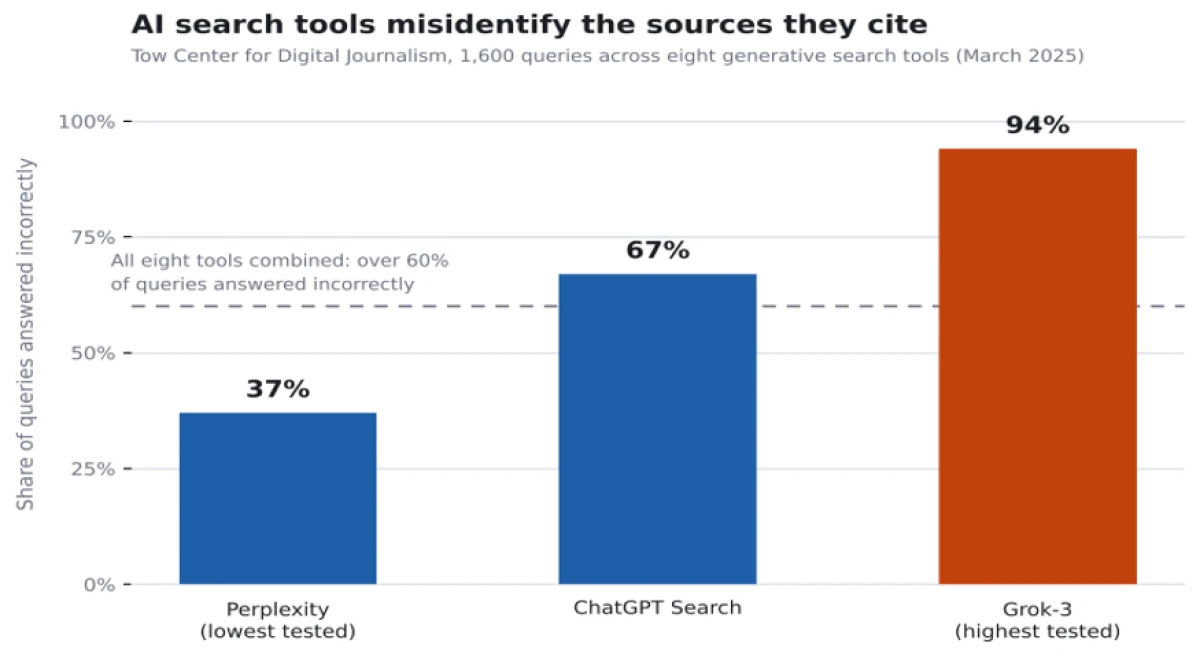
Figure 1. Citation error rates in AI search tools. Source: Tow Center for Digital Journalism, Columbia Journalism Review, March 2025.
Legal publishing shows the same pattern where errors are costly. Stanford RegLab and HAI researchers found Lexis+ AI and Ask Practical Law AI produced incorrect information more than 17% of the time, and Westlaw's AI-Assisted Research more than 34%, despite claims of hallucination-free citations. A database maintained by researcher Damien Charlotin had recorded 2,202 court decisions involving AI-hallucinated material as of 19 October 2026, mostly fabricated case law.
The risks for publishers fall into recognisable categories:
- AI hallucinations — confident statements with no underlying source.
- Outdated statistics — figures accurate years ago, presented as current.
- Incorrect dates, names and company details — the wrong founder, year, or a renamed company.
- Fake studies, quotations and citations — titles, authors and URLs that do not exist.
- Misleading comparisons — rankings and superlatives with no stated basis.
- Errors in financial, medical, legal and technical content — where inaccuracy causes real harm.
This is a research-based guide summarising published research and documented verification methods. It reports no first-hand experiments or tool testing.
How to Fact-Check AI Output Before Publishing: 7 Essential Steps
This workflow turns verification from a vague instruction into a repeatable process. Work through it in order.
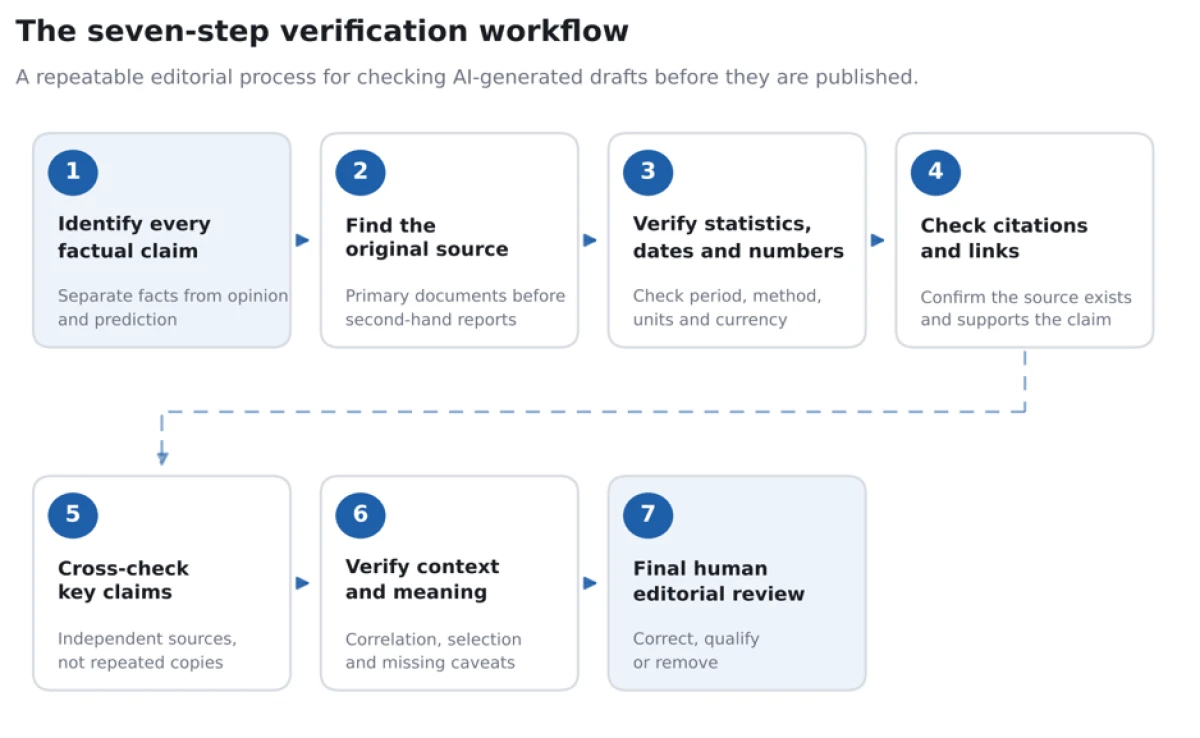
Figure 2. The seven-step verification workflow.
Step 1 : Identify Every Factual Claim
Read the draft once and mark every statement that could be proved true or false: statistics, dates, company and product names, prices and plan limits, specifications, job titles, quotations, study findings, and any sentence containing “the first” or “the largest.”
Leave opinions, predictions and recommendations unmarked. They need honest framing, but they are not verifiable facts. Put each flagged claim into a sheet with four columns: the claim, its status, the source used, the date checked.
Step 2: Find the Original Source
AI drafts often attribute a figure to whoever repeated it most prominently, not to whoever produced it. Walk the claim back to the document it came from: a peer-reviewed study, a statistics agency, a regulatory filing, an official announcement, technical documentation.
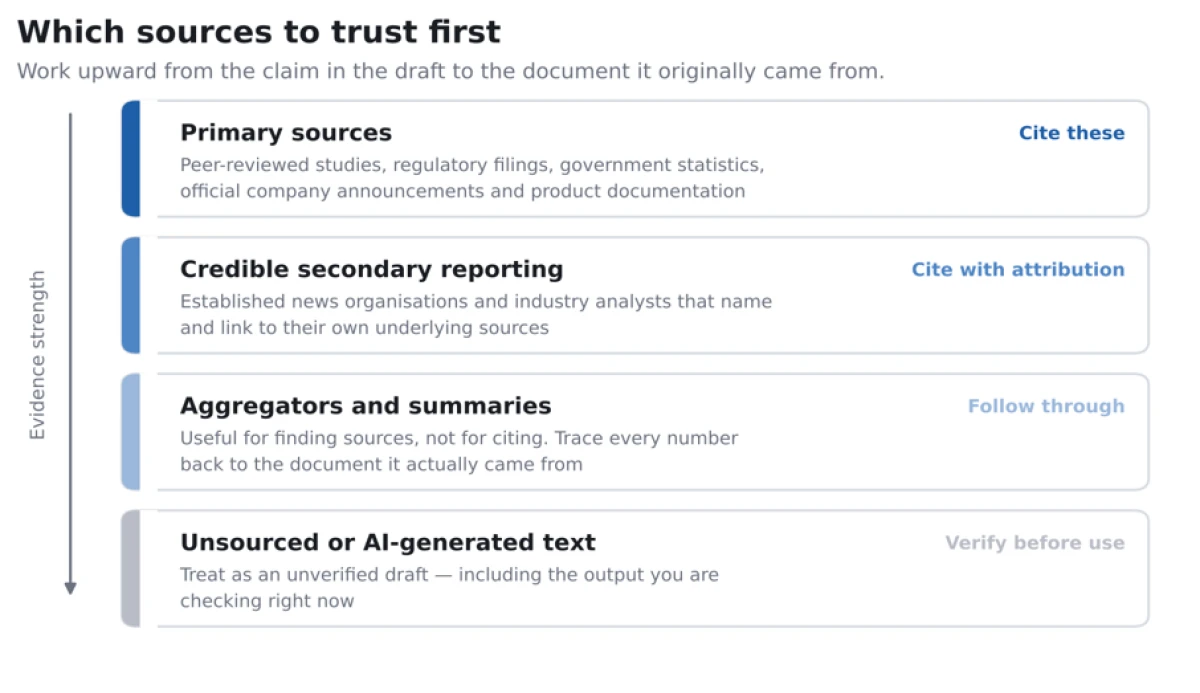
Figure 3. A working hierarchy of source quality.
Primary does not mean infallible. A press release selects favourable framing, a dataset may be revised, a study may have undisclosed funding. Primary sources tell you what was claimed and by whom; judging that claim is still your job.
Step 3: Verify Statistics, Dates and Numbers
For every number, check six things: when the data was collected (not when the article was published), the sample size, the methodology, the units, the currency, and the reporting period.
Time is where most numeric errors enter. An illustrative case: a draft says a sector grew 40% last year. The report is genuine, but the 40% covers 2021, a year distorted by pandemic-era demand. The number is accurate; the sentence is false. Anchor every figure to its period, “grew 40% in 2021, according to [source]”, rather than letting a vague time reference silently update a stale statistic.
Step 4: Check AI-Generated Citations and References
This step is skipped most often and has the highest error rate. AI systems generate correctly formatted references for sources that do not exist: plausible titles, real author names on papers they never wrote, journal names, DOIs and working-looking URLs.
Verification has two parts, and both are necessary:
1. Does the source exist? Search the exact title in Google Scholar, the publisher's site or the relevant database. Open the URL and confirm it resolves to that specific page, not a homepage or an error page.
2. Does it say what the draft claims? Read the relevant section. A real paper cited for a conclusion it does not reach is harder to catch than an invented one, and just as damaging.
Check quotations word by word against the original.
Step 5: Cross-Check Important Claims
For anything readers might act on, find corroboration from at least one independent source. If five websites report the same figure, check whether they are five investigations or five rewrites of one press release. Repetition is not corroboration — if they converge on one document, cite it as one source.
Where credible sources genuinely disagree, say so. “Estimates range from X to Y depending on methodology” is more trustworthy than silently picking the figure that suits you.
Step 6: Verify Context and Meaning
A sentence can be technically correct and still mislead. Check each verified claim for four distortions:
Correlation presented as causation. An observational study showing two things occur together does not show one causes the other. Read the methodology before writing “causes” or “proves.”
Selective statistics. A figure from a favourable window, or a percentage on a tiny base.
Overstated headings. If the body says “may reduce” and the heading says “reduces,” the heading is wrong.
Missing caveats. Limitations, small samples, preprint status and funding belong in the article when they change how a finding reads.
Step 7: Complete a Final Human Editorial Review
A second person reading the near-final draft against the claim tracker catches what the writer has stopped seeing. The reviewer confirms that every flagged claim has a status, that attributions name the actual originator, that figures match the cited documents, and that every link opens the intended page.
Any unresolved claim gets one of three treatments: correct it, qualify it (“according to one industry estimate”), or remove it. Publishing an unverified claim because it is probably fine is what produces corrections.
Common AI Hallucinations to Watch For
The examples below are illustrative patterns, not accounts of real incidents.
| AI Output Problem | Illustrative Example | How to Verify |
|---|---|---|
| Fabricated citation | A paper title and author returning no results anywhere | Search the exact title in Google Scholar and the publisher's site |
| Incorrect statistic | A market growth figure with no traceable origin | Locate the original industry or agency report |
| Outdated information | A subscription price that changed last quarter | Check the vendor's official pricing page today |
| Misattributed quotation | A known line assigned to the wrong speaker | Find the original transcript |
| False product feature | A tool described as offering an integration it lacks | Check the official documentation |
| Misleading conclusion | An observational study described as proving causation | Read the study's methodology and limitations |
Best Tools and Resources for Fact-Checking AI Content
No tool verifies an AI-generated article automatically. Each resource below answers a narrow question well; the editorial judgement stays with you.
Google Search — google.com. The fastest route to original sources. Quotation marks around an exact phrase find a claim's first appearance; the site: operator restricts results to an official domain. Limitation: results rank by relevance, not accuracy.
Google Fact Check Explorer — toolbox.google.com/factcheck/explorer. A searchable index of fact checks published by independent organisations worldwide; Google indexes them rather than performing them. Limitation: it covers only claims a participating publisher has already examined, skewing toward viral political and social topics.
Google Scholar — scholar.google.com. The quickest way to confirm a cited paper exists and read what it found; an exact-title search is an effective test for fabricated references. Limitation: Scholar does not vet the journals it indexes, so inclusion is not a quality signal.
Reuters Fact Check — reuters.com/fact-check. Reuters' fact-checking unit, operating since January 2020, publishing investigations into circulating claims, images and videos. Limitation: an archive of specific investigations, not a lookup service.
Official government and institutional databases — data.gov, Eurostat, SEC EDGAR, WHO, data.gov.in. The authoritative record for statistics, regulations, filings and health guidance. Limitation: figures are revised and publication lags leave recent periods uncovered.
How to Verify AI-Generated Content for Different Article Types?
AI and Technology News
Confirm announcements against the company's own newsroom or filing, not a rewritten report. Check dates, since documentation changes without notice. Distinguish between what is confirmed, what is in preview, and what is only rumour.
Software Reviews and Comparison Articles
Pricing, plan limits and features decay fastest. Check each against the vendor's live pricing and documentation pages on the day you publish, and note that date. Verify ratings on the platform itself. Never describe hands-on testing that did not happen.
Health and Medical Articles
Prioritise clinical guidelines from recognised bodies, systematic reviews and original research over secondary summaries, and note whether a finding is a preprint or a small trial. Where the topic affects reader decisions, arrange professional review and disclose it.
Finance and Business Content
Verify figures against regulatory filings, not news summaries. Confirm the reporting period and whether figures are audited, restated or preliminary. Check currency, conversion date, and whether amounts are in thousands, millions or crores. Timestamp market data.
A Practical Example of Fact-Checking AI Output
The walkthrough below is hypothetical, constructed to show the method. The findings described are not real research results.
1. The AI-generated claim. “According to a 2024 study by Harrington and Ruiz in the Journal of Enterprise Computing, companies that adopted workflow automation reduced operational costs by 47%.”
2. Why it needs verification. It carries every marker of a high-risk claim: named authors, a specific journal, a precise percentage and a causal relationship, the shape of citation AI fabricates most convincingly.
3. Which sources to consult. Search the exact title and author names in Google Scholar and the journal's archive. Confirm the journal exists, then locate the 47% figure in the results.
4. How to evaluate the evidence. If no such paper or journal exists, the claim is fabricated and must go. If the paper reports a different figure, correct it. If the figure comes from self-reported responses at twelve companies, say so. If the study is observational, the causal framing is unsupported.
5. A corrected version. Assuming a real but limited study: “In a 2024 survey of twelve enterprises published in [journal], respondents using workflow automation reported average cost reductions of 47% — self-reported, and too small a sample to be a benchmark.” If nothing checks out, the honest version is the sentence without the claim.
AI Content Fact-Checking Checklist Before Publishing
☐ Every important factual claim has been identified and has supporting evidence.
☐ Statistics, dates and reporting periods have been verified against the original data.
☐ Original sources have been consulted wherever available.
☐ Quotations match their original wording exactly.
☐ Every citation exists and genuinely supports the specific claim made.
☐ Every hyperlink opens the intended page.
☐ Prices, plan limits and features are current as of the publication date.
☐ Headings reflect the strength of the evidence, and conflicting evidence is addressed.
☐ Unsupported claims have been corrected, qualified or removed.
☐ No first-hand testing is claimed that did not occur.
☐ A human editor has reviewed the final draft against the claim tracker.
Can AI Fact-Check Its Own Output?
Not in any way you can rely on. A model asked whether its previous answer was correct generates another prediction from the same training and context. It has no independent access to the facts and may confirm a fabrication as readily as it produced one. The Tow Center research found these tools rarely acknowledged uncertainty even when wrong — precisely the failure self-checking would need to overcome.
AI does help with the parts of verification that are about organisation rather than truth: extracting claims into a list, suggesting search queries, comparing a draft against a source document you supply, flagging contradictions. What it cannot do is supply the evidence. Confirming that a source exists and fairly supports the claim means opening the document and exercising judgement.
Final Thoughts
Verification is a process, not an instinct. Teams that reduce factual errors make the seven steps routine: a claim tracker on every draft, primary sources preferred over repetition, citations opened and read rather than trusted, and a named human signing off. The cost is modest, an hour on a long article, against a correction, a lost reader, or a claim that cannot be defended. Treat AI output as a capable first draft from a writer who never checks anything.
Frequently Asked Questions
What is the best way to verify AI-generated statistics?
Find the original data source — a government agency, peer-reviewed study or regulatory filing, rather than a report quoting it. Confirm the collection period, sample size, methodology and units, then state the period explicitly in your article.
Are AI-generated citations reliable?
No. AI systems routinely produce correctly formatted references to papers and URLs that do not exist, and cite real sources for claims they never make. Every citation needs two checks: the source exists, and it supports the statement attributed to it.
Can AI tools fact-check their own responses?
Not reliably. Asking a model to check itself produces another prediction from the same context, so it may confirm its own errors. AI can extract claims and compare a draft against a supplied document, but the evidence and final judgement must come from a human.
Should you fact-check AI content before publishing on a website?
Yes, always. An unverified claim exposes you to reader harm, reputational damage and, in regulated subjects, legal risk. Search guidance rewards content that demonstrates accuracy and accountability, and verification is the mechanism that produces both.

Olivia Bennett is a technology writer at TechJox with over 8 years of experience creating detailed how-to guides, software tutorials, troubleshooting articles, and step-by-step walkthroughs. She specializes in Windows, Android, iOS, AI tools, software applications, browser settings, and everyday tech solutions. Her expertise includes simplifying technical processes, resolving common software issues, and explaining digital tools through practical, beginner-friendly instructions. Olivia focuses on making technology easier to navigate, helping readers solve problems confidently and get the most out of their devices and applications.
Discussion (0)
You need a free TechJox account to join the discussion and report scams you spot.