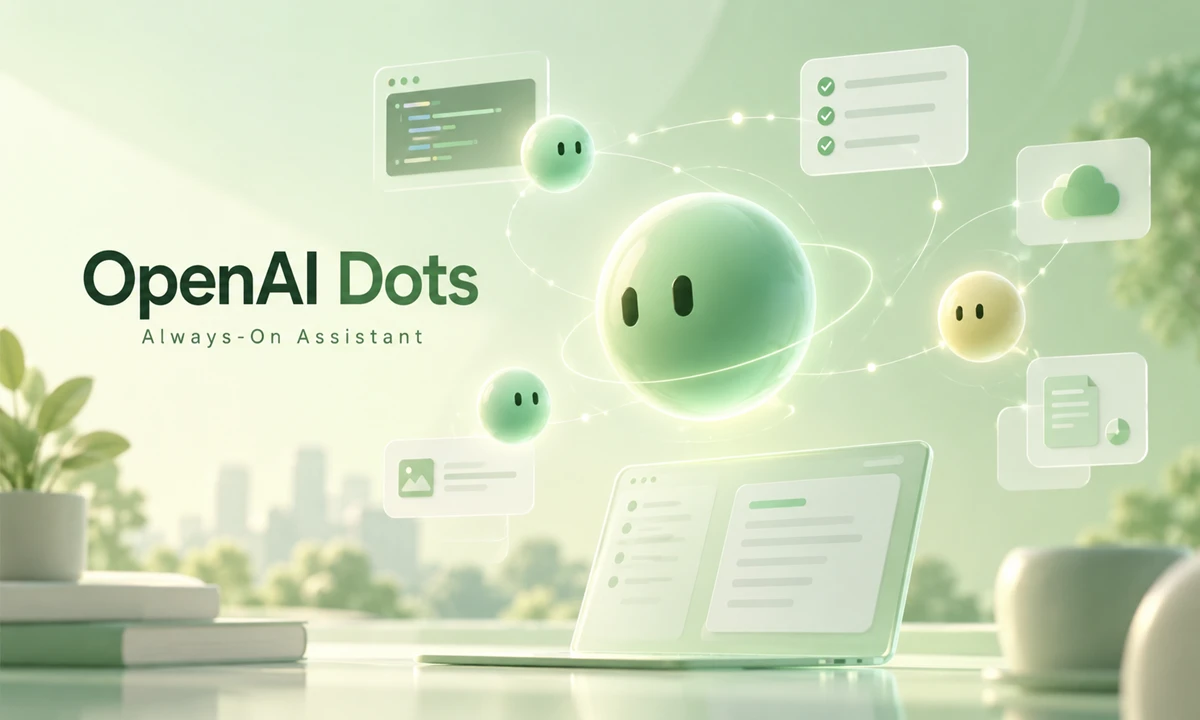
OpenAI has quietly reframed one of its most powerful engineering achievements into a product aimed at everyone. The always-on assistant that keeps working in the background, even when you haven’t asked it to, has become this year’s answer to how people will actually use large language models. and OpenAI’s entry, “dots,” is built almost entirely on the coding tools it created for developers.
Unveiled at OpenAI’s DevDay, dots are personal agents powered by the company’s latest model, GPT-6 Astra. OpenAI describes them as remarkably capable, always-on agents built to handle everything, designed to pursue a user’s goals continuously with minimal oversight rather than simply responding to a single prompt. Days after the launch, Alexander Embiricos, the product lead for dots, took the stage at TechCrunch Disrupt 2026 in a session titled “What Comes After the Chatbot?” to explain how the product came together.
From Codex to an Everyday Assistant
The technical foundation for dots comes from an unexpected place: OpenAI’s coding tools. According to Embiricos, much of what dots can do could already be approximated using Codex, the company’s agentic coding tool, but doing so required far more manual effort. The breakthrough was less about inventing new technology and more about presentation. As Embiricos framed it, a great deal of the work was not adding a new piece of tech to the product, but rather how it is framed to the user and how it feels.
It is a path OpenAI had already started down. The company previously built ChatGPT Work by adapting the agentic coding tools it originally designed for software engineers. Dots extends that same logic one step further, taking the persistence and autonomy that made coding agents useful and wrapping them in an interface meant for anyone, not just programmers.
What a “Dot” Actually Is
Unlike a standard chatbot session, each dot operates with its own computer and browser running in the cloud, which keep working even when a user’s laptop is switched off. A user assigns a dot a responsibility, keeping a product launch on track, following up on bug reports, monitoring a project, and it continues making progress between conversations, returning completed work for approval and learning preferences over time.
Dots can connect to more than 4,000 applications, including workplace tools such as Slack and Microsoft Teams, and users can message their agents through those platforms, with text-message support planned. OpenAI has also described “specialist dots” that take on narrower roles, each provisioned with its own identity, credentials and tools, and it is working with Microsoft to integrate dots into Agent 365 security controls. In its announcement, OpenAI said it envisions teams of dots eventually working together on a user’s behalf.
The examples OpenAI offered span both work and daily life: an agent scanning incoming bug reports to flag recurring errors and prepare code patches for an engineer to review; a content creator handing over an interview transcript so a dot can pull video clips, draft social posts and write articles; and more mundane errands such as booking a restaurant table or designing a website.
Why “Dots”?
The name is a deliberate nod to OpenAI’s own branding. “Dots” refers to the negative space inside the company’s logo, and the small floating cartoon avatars are intended, in Embiricos’s words, to feel like something that could eventually be ubiquitous. It is the latest attempt by an AI company to make the technology feel more relatable and personable rather than purely utilitarian.
Proactive by Design, and Hungrier for Data
A defining feature of dots is a capability OpenAI calls “proactive research,” in which the assistant anticipates what a user might need before being asked. Embiricos described the goal as an assistant that is effectively thinking about the user and how to help them. OpenAI leaders have emphasized endurance as a differentiator: Thibault Sottiaux, head of core products, said at a post-DevDay briefing that dots are capable of staying focused on a task for very long periods.
That ambition comes with trade-offs. A more anticipatory agent consumes more computing resources, meaning more token usage for OpenAI, and its usefulness depends heavily on access to a user’s personal information, raising familiar questions about how much data people are willing to hand to a software company. Early hands-on testing by reporters suggested the forward-thinking behavior is genuinely useful at times but not yet fully realized.
Privacy and Control
OpenAI says dots carry the same privacy controls as ChatGPT. Users can turn off model training to prevent their conversations from being used to improve OpenAI’s models, and they can manage which resources an agent is allowed to reach on their computer. Access to a local machine is optional and turned off by default, and only one personal computer can be connected at a time.
The company has also built in guardrails on autonomy. While a dot can learn preferences and propose solutions on its own, high-risk operations, such as changing an account password, are designed to always require manual human approval. OpenAI has acknowledged that its current privacy controls are relatively coarse and has said it plans to introduce finer-grained options after gathering user feedback.
Pricing and Availability
Dots became available at launch in ChatGPT for Pro and Business Premium users in eligible markets, and can be started from either ChatGPT or Codex. Pricing for the Pro tier starts at around $100 a month, placing the feature firmly in OpenAI’s premium bracket rather than its free or entry-level offerings, at least for now.
A Crowded Race for the Always-On Assistant
OpenAI is far from alone. The push toward persistent, background-running assistants has become one of the defining competitions in AI. Meta launched its own always-on agent, Muse, in early September 2026, roughly three weeks before DevDay, and Google unveiled Gemini Spark earlier in the year. Startups including xAI’s Instinct and a company called Hark are chasing the same vision, with some, like Hark, positioning themselves explicitly around not harvesting user data for advertising.
For OpenAI, dots represent a strategic shift from competing on individual features to competing on platform. By turning the autonomous infrastructure behind its coding agents into a consumer-facing assistant, the company is betting that the heritage of its developer tools can deliver the kind of reliable, proactive help that earlier generations of digital assistants repeatedly promised but never quite achieved.
What Comes After the Chatbot?
The question Embiricos posed on stage, what comes after the chatbot, captures the stakes. If dots and their rivals succeed, the primary way people interact with AI could shift from typing questions into a box toward delegating ongoing responsibilities to agents that act on their behalf. OpenAI’s own leadership has signaled that adoption will be driven less by headline scientific breakthroughs than by everyday convenience, and that absorbing these more capable agents into daily life will take time.
Whether users ultimately trust an assistant that is always watching, always working and always learning may prove to be the decisive factor. For OpenAI, the gamble is that the tools it built to help machines write code can be reframed, repackaged and softened into a companion that helps people get through their day, sometimes, as the company puts it, before they even think to ask.

With experience writing 500+ pieces of content across different formats, I focus on making technology and cybersecurity topics clear, informative, and accessible. At **TechJox**, I cover tech news, cybersecurity trends, digital safety, and practical guides that help readers stay informed and make better decisions. My approach combines research, accuracy, and simple storytelling to turn complex information into useful, engaging, and easy-to-understand content.
Discussion (0)
You need a free TechJox account to join the discussion and report scams you spot.