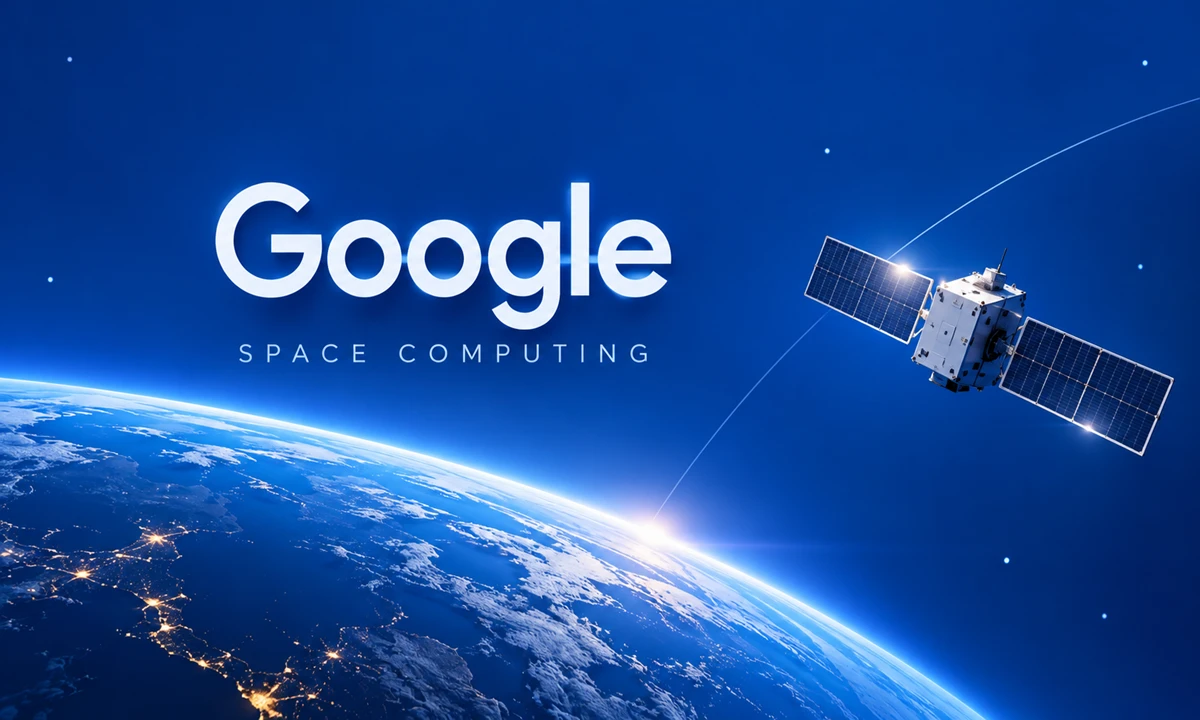
Google has pulled a modern AI model off the ground and run it from space. On October 30, the company said its Project Suncatcher prototype satellite received a command from Earth, powered up an onboard chip, executed a prompt, and sent back a complete answer. The answer arrived as a haiku, downlinked as the spacecraft passed over Svalbard in northern Norway.
- Blue marble below
- Data streams in silent grace
- Starlight feeds my core
Travis Beals, who leads the Paradigms of Intelligence team at Google, described the moment in a research post as the mission's "Hello World" milestone, and as the first AI response generated by a data-center-class chip operating in orbit. The verse is slight on purpose. What matters to the engineers is that a prompt went up, a model ran on real hardware in a hostile environment, and a coherent response came back down.
What is actually in orbit?
The satellite is a single prototype, not a constellation. Google built it with Planet, the Earth-imaging company, and launched it on October 1 aboard a SpaceX Falcon 9 as part of the Transporter-18 rideshare, sharing the ride with more than a hundred other spacecraft. Google confirmed contact with the satellite the same day and then spent several weeks commissioning it before trying any compute.
Onboard are four Tensor Processing Units, Google's in-house chips for machine learning and the same family that runs AI workloads in its terrestrial data centers. The whole unit draws roughly one kilowatt from its solar panels, which is a tight power budget. That limit is why only one of the four chips can run at a time. The model doing the writing is Gemma 4, Google DeepMind's open-weight model, running directly on the orbital TPU rather than phoning home to a server.
Why move compute off the planet?
Project Suncatcher started as a public research effort in November 2025. The premise is straightforward even if the execution is not. In the right orbit, a dawn-dusk sun-synchronous path, a spacecraft sits in almost constant sunlight. Solar panels there collect far more energy, far more steadily, than panels on the ground. Google's argument is that a cluster of satellites in such an orbit could run large AI inference jobs on near-continuous solar power, without pulling from electricity grids that are already straining under data center demand and without the cooling constraints that bound facilities on Earth.
The company is candid that this is a long horizon bet. Suncatcher is aimed at infrastructure that might be economical in the 2030s, not next quarter. The prototype exists to answer the first hard question any of that depends on: can Google's chips survive the trip to orbit and keep computing reliably once there.
The radiation problem
Space is unkind to silicon. High-energy particles strike memory and logic, flipping bits in ways that can quietly corrupt a computation without setting off the monitoring tools a chip would rely on at ground level. Google tested its TPUs in particle accelerators before launch to gauge how they would hold up, targeting a five-year operational life in low Earth orbit. Accelerator tests are a proxy, though. Real orbital radiation is the actual exam, and running Gemma 4 without the answer dissolving into garbage is the first sign the hardware passes.
Alongside the poem, Google asked the satellite to report on the conditions around it. A company spokesperson said the spacecraft was operating nominally. It is expected to keep running experiments for about a year, gathering data on how the chips handle radiation, heat, and the physical stress of spaceflight.
What comes next?
One satellite cannot be a data center. The real test of the Suncatcher concept is whether many spacecraft can fly in tight formation and pass data between themselves fast enough to behave like a single machine. Google's research points toward compact groups of satellites separated by about a kilometer, linked by free-space optical connections, with a long-term formation design running to dozens of craft flying in close proximity.
The next concrete step is a pair. Google plans to put two satellites in orbit in 2027 to test whether an AI computation can be split across more than one spacecraft, to generate more power, and to demonstrate the optical links that would carry data between them. Until those links and that coordination are proven, Suncatcher stays firmly in the experiment column rather than the product column.
For now the headline act is a chip the size of a few phones, circling the Earth on sunlight, answering a question with a poem about the view. The implications the company is chasing sit well beyond the poetry.

Olivia Bennett is a technology writer at TechJox with over 8 years of experience creating detailed how-to guides, software tutorials, troubleshooting articles, and step-by-step walkthroughs. She specializes in Windows, Android, iOS, AI tools, software applications, browser settings, and everyday tech solutions. Her expertise includes simplifying technical processes, resolving common software issues, and explaining digital tools through practical, beginner-friendly instructions. Olivia focuses on making technology easier to navigate, helping readers solve problems confidently and get the most out of their devices and applications.
Discussion (0)
You need a free TechJox account to join the discussion and report scams you spot.