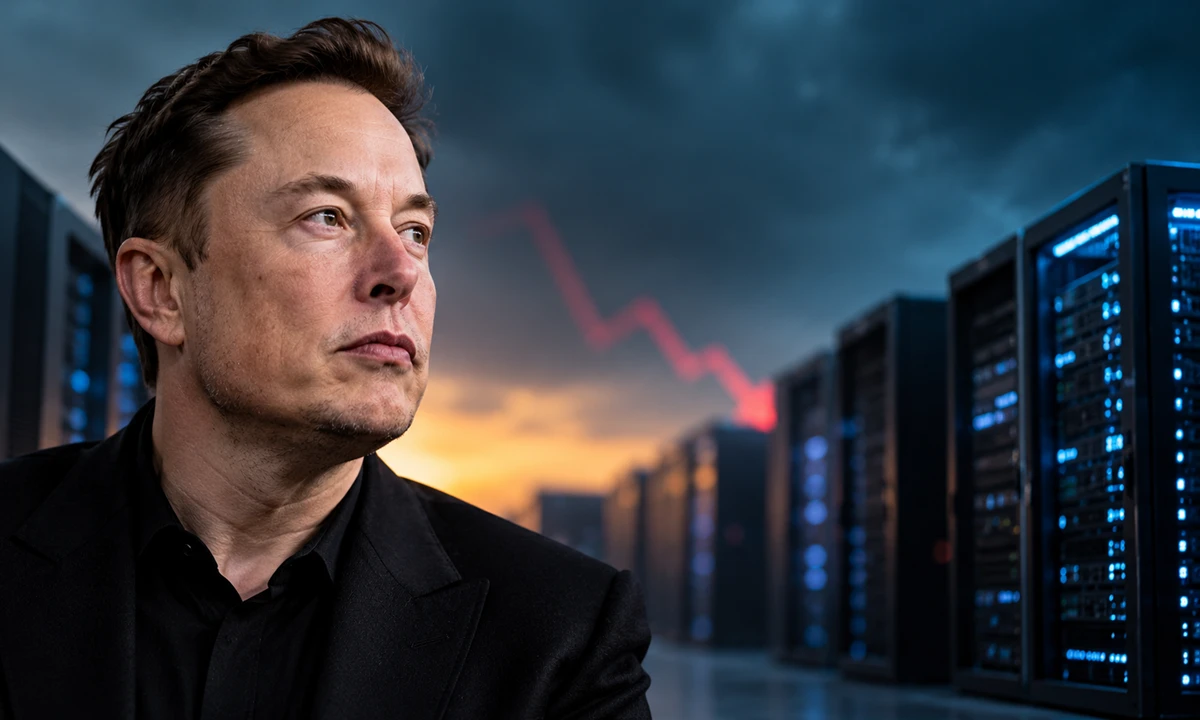
Elon Musk has warned that more than 200 specialised artificial-intelligence cloud providers could collapse or be swallowed up as access to debt financing tightens, raising fresh questions about the sustainability of businesses built on expensive, borrowed computing power. The billionaire, who runs SpaceX and xAI, said only a few of these firms are likely to endure.
Musk made the comments in a post on X on October 25, 2026, responding to discussion about the heavy debt loads carried by AI infrastructure companies. His remarks landed the same weekend that SpaceX moved to close one of the largest debt financings ever raised to buy AI chips, a contrast Musk himself drew to explain why his company is positioned to weather the squeeze while smaller rivals are not.
What Musk actually said?
In his post, Musk argued that lenders have pulled back sharply from companies whose only meaningful revenue comes from AI data centres. According to the message, debt markets have “almost entirely shut off” access to capital for any firm that lacks substantial income independent of that infrastructure. He predicted widespread failures and consolidation among the 200-plus neocloud providers, adding that some would make it through “but not many.”
Musk warned that recent weeks had seen debt markets close off funding for companies without revenue independent of AI data centres, and said the result would be heavy failures and consolidation among the 200-plus neoclouds, with only a few surviving.
Musk also pointed to SpaceX’s own position as the exception. He noted that the company had closed roughly $40 billion of debt to buy graphics processing units (GPUs), but stressed that SpaceX carries an investment-grade credit rating and earns substantial revenue from its Starlink satellite-internet service and rocket launches, income streams that stand apart from its AI data-centre ambitions. He separately dismissed the idea of SpaceX acquiring struggling neoclouds, calling such a move pointless.
What is a “neocloud,” and why it matters?
Neoclouds are specialised providers that supply the raw computing power needed to train and run AI models. Rather than build general-purpose cloud platforms, they concentrate on high-density GPU clusters and the high-speed networking around them, renting that capacity to AI developers and larger cloud operators that cannot expand their own data centres fast enough.
The business model is capital-hungry by design. Operators borrow heavily, often against the GPUs themselves or against long-term customer contracts, to buy chips that can cost tens of billions of dollars to deploy at scale. That leverage works while financing is cheap and demand is rising. It becomes dangerous when lenders grow cautious, because these companies depend on continuous borrowing to fund expansion and refinance maturing debt. Prominent names in the sector include CoreWeave, Nebius, Lambda, Crusoe and IREN.
A sector already under strain
Musk’s warning did not come out of nowhere. In the weeks beforehand, nervousness about debt-financed AI infrastructure had already rattled markets. Borrowing costs for some neoclouds have climbed as investors reassessed the risk: yields on certain CoreWeave bonds, for instance, rose sharply through the year as debt investors priced in a greater chance of trouble.
Industry analysts have also flagged structural fragility in the model. Research firm Gartner has cautioned that a large majority of neocloud providers may be unable to continue operating independently by the end of the decade, as cost pressures and a lack of differentiation force consolidation, a view broadly in line with Musk’s. Much of the sector’s borrowing is short-dated and clusters into a refinancing window between 2026 and 2028, a pattern some commentators have dubbed the “neocloud refinancing wall.”
SpaceX’s $40 billion chip bet
Musk’s comments arrived alongside news of SpaceX’s own aggressive push into AI computing. The company has moved to raise about $40 billion in debt to buy Nvidia AI chips, with the hardware expected to arrive in the first and second quarters of 2027. Reuters reported that SpaceX had been in talks with banks and investors over the financing, while Bloomberg reported the package was being structured through a special-purpose vehicle, with Goldman Sachs leading discussions and investors including Apollo Global Management involved.
Reporting has described the structure as roughly $10 billion in bank loans and $30 billion in investment-grade debt, though the final terms have not been fully confirmed. Reuters noted that pricing discussions were still ongoing despite Musk’s announcement, so the exact shape of the deal may yet change.
SpaceX by the numbers (Q3 2026)
| Metric | Figure |
|---|---|
| Total quarterly revenue | $14.58 billion (up ~161% year-on-year) |
| AI business revenue | $7.56 billion (vs. $813 million a year earlier) |
| Expected Q4 2026 capital expenditure | $35 billion – $40 billion |
| GPU debt financing (reported) | ~$40 billion, chips due Q1–Q2 2027 |
Figures as reported by Reuters, Bloomberg and CNBC. Deal terms remain subject to change.
Those results underline the distinction Musk was drawing. SpaceX’s AI arm has become its fastest-growing segment, but the company also sits on large, diversified revenue from Starlink and launches, plus an investment-grade rating, precisely the kind of financial backstop that most standalone neoclouds lack.
What it means
Taken together, Musk’s warning and SpaceX’s financing sketch a widening divide in the AI infrastructure race. Well-capitalised players with independent revenue and strong credit can keep borrowing to buy chips at scale. Smaller, debt-dependent neoclouds, reliant on a narrow base of customers and on lenders’ continued appetite, face a harder road if credit stays tight and their contracts or financing come under pressure.
Whether the shakeout is as severe as Musk suggests remains to be seen. His predictions are pointed, and as an operator of a rival AI compute business he is not a neutral observer. But the broader signals, rising borrowing costs, cautious analysts and a looming refinancing wall, point in the same direction: the era of easy money for AI data centres is tightening, and not every company that rode the boom is likely to survive it.

Olivia Bennett is a technology writer at TechJox with over 8 years of experience creating detailed how-to guides, software tutorials, troubleshooting articles, and step-by-step walkthroughs. She specializes in Windows, Android, iOS, AI tools, software applications, browser settings, and everyday tech solutions. Her expertise includes simplifying technical processes, resolving common software issues, and explaining digital tools through practical, beginner-friendly instructions. Olivia focuses on making technology easier to navigate, helping readers solve problems confidently and get the most out of their devices and applications.
Discussion (0)
You need a free TechJox account to join the discussion and report scams you spot.