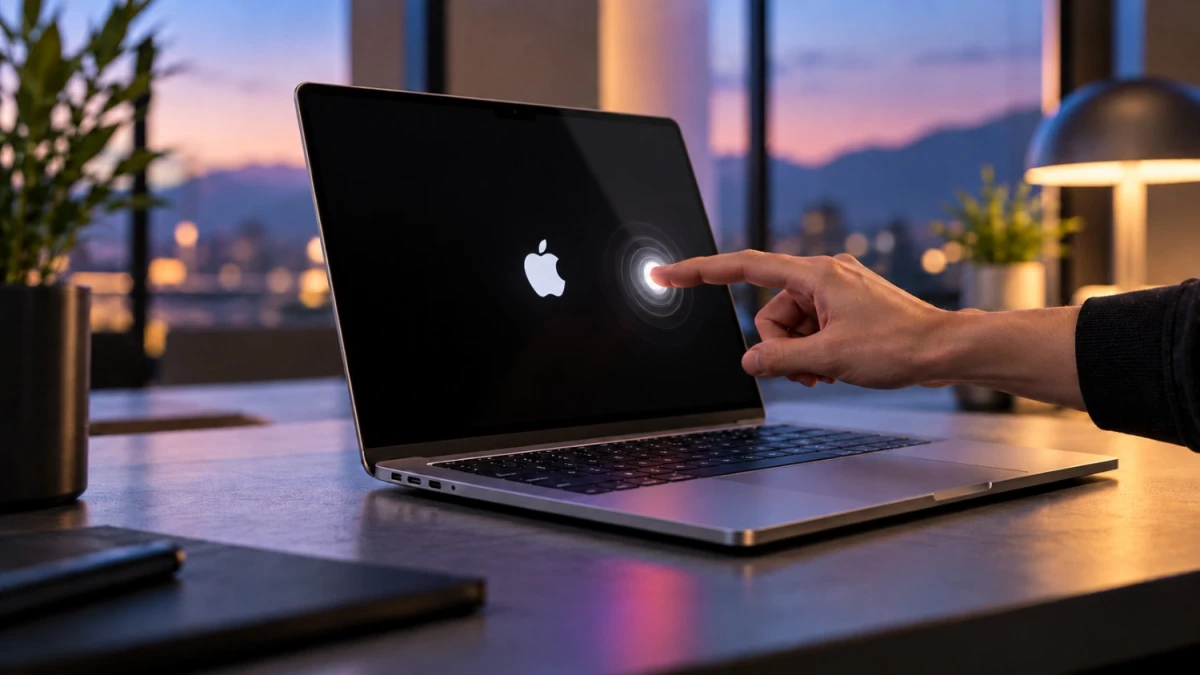
Apple has introduced its first MacBook Pro with a touchscreen, adding touch controls and a tandem OLED display to its high-end laptop line. The 14- and 16-inch models start at $2,899 in the U.S. and are available to preorder, with deliveries and in-store availability beginning November 6. Apple calls the new screen PROLED XDR. It combines tandem OLED technology with a 120Hz variable refresh rate and up to 2,000 nits of peak brightness.
The launch changes how customers can interact with a MacBook Pro, but it does not replace the keyboard or trackpad. Apple presents touch as an additional way to work with content, from scrolling and zooming to drawing, arranging windows and using compatible creative apps.
Touch Comes to Mac
The new MacBook Pro supports familiar gestures, including swiping to scroll, pinching to zoom and dragging items across the screen. Apple says the touch sensor is built into the display panel to reduce input delay. A redesigned hinge is intended to keep the display steady while users tap it.
The touch features are designed to work alongside the keyboard and trackpad. Apple’s own apps are optimized for the new screen, and existing Mac apps can respond to touch as clicks. Developers can also use updated system tools to build controls specifically for touch. Apple says several third-party productivity, creative, 3D design and music apps are expected to add support.
The change could be useful in workflows that benefit from direct interaction with what is on screen. Designers can draw across the display, musicians can play software instruments by tapping, and developers can test touch interactions for iPhone and iPad apps. For routine laptop tasks, the keyboard and trackpad remain central to the experience.
Tandem OLED Display
Apple is introducing the display under the name PROLED XDR. It uses two OLED pixel layers and supports up to 2,000 nits of peak HDR and SDR brightness, a 10,000,000:1 contrast ratio and adaptive refresh rates up to 120Hz. The display also supports P3 and Adobe RGB color spaces, features aimed at people who edit photos, video and other color-sensitive work.
The screen is available in both 14-inch and 16-inch MacBook Pro models. Apple says the new laptops are thinner and lighter, with up to 24 hours of battery life. The redesign also brings Dynamic Island to the Mac, where it displays Spotlight search, Live Activities and Siri AI. The laptops include M5 Pro or M5 Max chips, up to 128GB of unified memory and configurations with up to 16TB of storage.
Apple has not paired the touchscreen redesign with new M6 Pro or M6 Max processors. The high-end models retain M5 Pro and M5 Max, while M6 appears in a separate, lower-priced 14-inch MacBook Pro. That gives customers a choice between paying more for the new display and touch controls or choosing the newer base chip in a model without those features.

A $900 Price Gap
The 14-inch touchscreen MacBook Pro with M5 Pro starts at $2,899 in the U.S. The 16-inch version starts at $3,399. Configurations with M5 Max start at $4,499 for the 14-inch model and $4,799 for the 16-inch model. Apple began taking preorders on October 28, and the models are due to reach customers and stores on November 6.
The lower-priced 14-inch MacBook Pro with M6 starts at $1,999. It uses a Liquid Retina XDR display rather than the new tandem OLED screen, and Apple does not list touch support for this model. Apple says the M6 version has a 12-core CPU and GPU, up to 24 hours of battery life, and up to 30 percent faster graphics and 25 percent faster on-device AI performance than the M5 model used for comparison. It also includes 16GB of unified memory as standard.
The $900 difference between the entry M6 model and the entry touchscreen version makes the choice relatively clear: buyers who want touch and the new OLED display must move into the higher-priced tier. The price gap is not just for touch, since the OLED model also includes M5 Pro silicon and other hardware changes. Apple is keeping non-touch MacBook Pro models on sale, so customers can still choose a traditional display configuration.
Other Product Updates
Apple’s product announcements this week also include an M6 iMac and a redesigned iPad mini. The 24-inch iMac keeps its 4.5K Retina display and seven-color design while gaining the M6 chip, Wi-Fi 7 and Bluetooth 6. U.S. pricing starts at $1,499 for the 10-core CPU and GPU configuration, with a higher configuration starting at $1,699. Apple says preorders began October 28, with availability set for November 6.
The iPad mini moves to OLED with an 8.5-inch display and gains the A20 Pro chip, a landscape-positioned front camera and an IP67 rating for water and dust resistance. Its U.S. starting price is $699 for the Wi-Fi model, up from $599 for the previous generation. The cellular version starts at $849. Apple opened preorders on October 28 and lists November 6 as the availability date.
What Changes for Buyers
The touchscreen MacBook Pro is a notable shift in Apple’s laptop design, but its high price positions the feature as an option for customers already considering a premium Pro model. The screen and touch controls may matter most to people who work directly with visual or musical content. For many others, the M6 MacBook Pro offers a newer chip and long battery life at a substantially lower starting price.
Apple’s lineup now separates the choice more sharply: the M6 model brings the latest base chip to the 14-inch MacBook Pro, while the OLED touchscreen versions introduce a new way to interact with macOS at a higher cost. Buyers can compare the two in stores from November 6, when all four announced products are scheduled to become available.

Ethan Mitchell is a technology writer at TechJox, specializing in artificial intelligence, cybersecurity, SaaS platforms, software applications, and digital automation. His writing covers AI tools, data privacy, emerging technologies, and software reviews, with a focus on practical insights, clear explanations, and helping readers make informed technology decisions.
Discussion (0)
You need a free TechJox account to join the discussion and report scams you spot.