The two biggest names in American retail have landed on opposite sides of the agentic-shopping question. The split says less about artificial intelligence than it does about who gets to own the moment a shopper decides what to buy.
When economist Tyler Cowen asked OpenAI chief Sam Altman last year whether Amazon would ever let people buy through ChatGPT the way Walmart had just agreed to, Altman did not hedge about the strategy he would pick in Amazon’s seat. “If I were them, I would fight back,” he said. Months on, that is more or less what Amazon has done, while its largest rival has moved in the opposite direction.
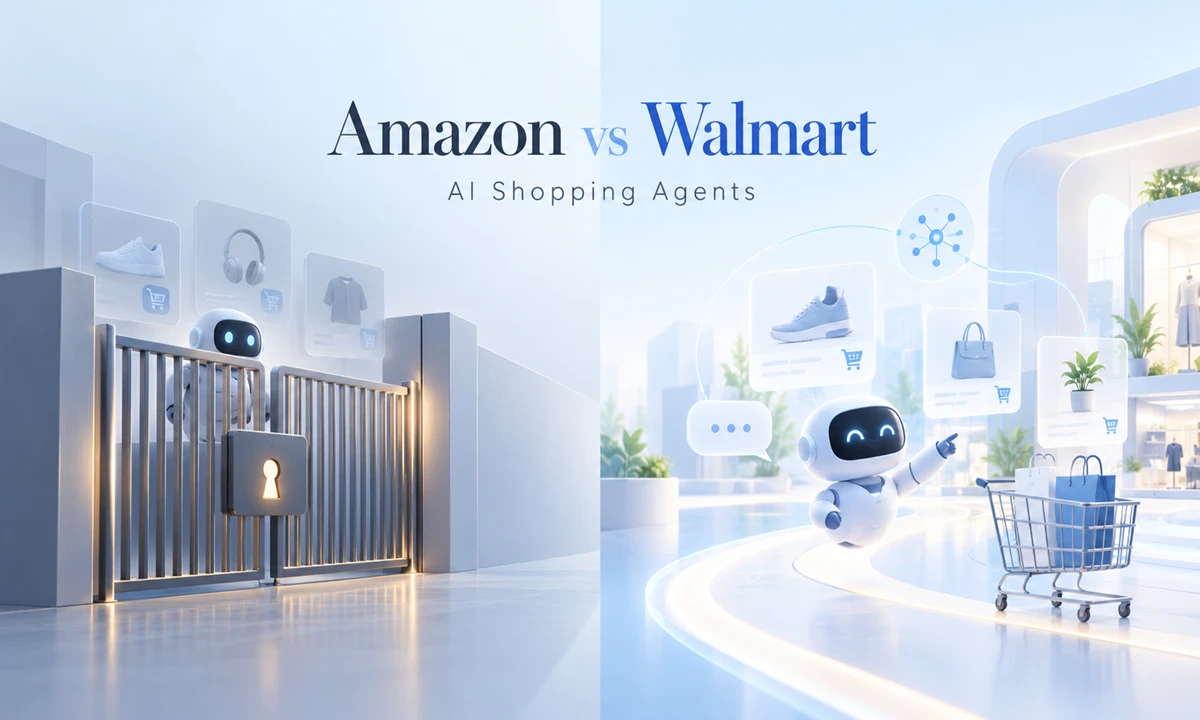
The result is a clear fork in the road for agentic commerce, the emerging model in which AI assistants search for products, compare them and, increasingly, complete the purchase on a shopper’s behalf. Amazon is tightening the gates. Walmart is holding the door open. Understanding why requires looking past the technology and at the business underneath it.
What Amazon Actually Changed
The flashpoint was a quiet edit to a file most shoppers never see. Amazon updated its robots.txt, the plain-text instructions that tell automated crawlers which parts of a site they may touch to disallow more of OpenAI’s bots. On top of the previously blocked GPTBot, which gathers text to train ChatGPT, Amazon added rules against ChatGPT-User, the agent that fetches live information when someone asks a question, and OAI-SearchBot, which feeds OpenAI’s search product.
Independent e-commerce analyst Juozas Kaziukėnas was first to flag the change, and Modern Retail confirmed it by inspecting the code behind Amazon.com. It was not a one-off: Amazon had already restricted crawlers tied to Google, Perplexity, Anthropic’s Claude and Meta, according to reporting by The Information. The practical effect is that Amazon’s product pages have stopped appearing in some AI-generated shopping answers.
One caveat matters for context. A robots.txt block is a request, not a wall. Well-behaved crawlers honor it, but the file carries no real enforcement muscle, which is partly why Amazon has also reached for sterner tools.
The Real Motive Is Advertising, Not a Fear of Robots
Amazon’s resistance is easier to read once the money is on the table. The company earns roughly $56 billion a year from advertising, a business that lives or dies on people browsing Amazon.com, where sponsored placements sit beside search results. If an AI agent does the browsing and hands back a single recommendation, those ads are simply skipped.
Amazon also has an unusually strong position to defend. It accounts for close to 40% of all U.S. e-commerce spending, and roughly 90% of its shoppers begin their product searches on its own site. Being the default starting point is the asset in question. Should agents become the place people start instead, Amazon risks losing its grip on both discovery and the ad dollars that flow from it. As Scot Wingo, who advises brands on agentic AI, put it, Amazon wants to remain the front door of online shopping rather than becoming the plumbing behind someone else’s storefront.
The Perplexity Flashpoint
The dispute turned openly adversarial with Perplexity. Amazon sent the AI startup a cease-and-desist letter over its Comet browser, which let an agent find and buy products on Amazon for a user. Amazon argued the behavior amounted to computer fraud and accused Perplexity of using concealed agents to operate inside its store without permission. Perplexity fired back, characterizing the legal threat as bullying rather than a legitimate objection.
Amazon’s public position is that third-party agents should work in the open and respect a retailer’s decision on whether to let them in at all, a framing that casts the blocks as a matter of consent rather than protectionism.
Amazon Isn’t Anti-AI: It’s Anti Everyone Else’s AI
The gates are selective, not absolute. While Amazon keeps rival agents out, it is pouring resources into its own. Rufus, its shopping assistant, now sits alongside features like Auto Buy, which purchases an item automatically when its price drops, and Buy For Me, a test that lets shoppers order from other websites without leaving Amazon’s app. The company says people who use Rufus are about 60% more likely to complete a purchase and expects the assistant to drive more than $10 billion in annual sales.
Nor has Amazon slammed the door forever. CEO Andy Jassy has said the company is in conversations with outside shopping agents and expects to find ways to work with them over time, while complaining that many of today’s agents pass along inaccurate pricing, delivery and inventory details. Read together, the message is that the door is bolted, not bricked and Amazon intends to hold the key.
Walmart’s Open Door
Walmart chose the opposite posture. It left its robots.txt untouched where agents are concerned, and in October 2025 it struck a partnership with OpenAI that let shoppers buy Walmart products directly inside ChatGPT. The company has described the shift as a move toward a more conversational, anticipatory way of shopping, a native AI experience in place of the familiar search bar and endless results list.
At the same time, Walmart has been building its own stack. Its consumer assistant, Sparky, introduced in mid-2025, is one of four “super agents” the retailer has organized its AI around: Sparky for customers, Marty for suppliers and advertisers, and separate agents for store associates and developers. The strategic logic differs from Amazon’s because the numbers do. E-commerce is a smaller share of Walmart’s overall sales, and advertising is not yet its primary profit engine, so capturing AI-driven demand reads as upside to chase rather than a core business to protect.
The Welcome Mat Has Fine Print
“Open,” though, does not mean handing over the keys. By early 2026 Walmart had pulled back from relying on OpenAI’s own checkout and pivoted to distributing Sparky itself across outside platforms, including ChatGPT and Google’s Gemini. The distinction is the whole game: rather than letting a platform own the transaction, Walmart is pushing its own agent to wherever shoppers happen to be. It has also lined up behind shared technical standards for agentic commerce alongside companies such as Shopify and Target.
Walmart executives have been careful to separate this from pure automation. The company frames agentic commerce as a way to expand the market and sharpen personalized discovery, distinct from “robotic commerce” that merely reorders the same items on a schedule. In that telling, the welcome mat is strategic, not naive.
Where Everyone Else Is Standing
The rest of retail is scattered across the middle of the spectrum. Shopify permits agents but guards the checkout, requiring them to route purchases through Shop Pay so a human approves the final step. Target has moved to launch its app inside ChatGPT and is working with both ChatGPT and Gemini. Etsy has made merchant products available through ChatGPT’s instant checkout, and eBay, like Walmart, has not moved to block agents. Amazon is increasingly the outlier at the restrictive end, not because it rejects AI, but because it has the most to lose if discovery moves elsewhere.
Why the Split Matters
The stakes are easy to understate while the volumes are small. OpenAI’s own researchers estimate that ChatGPT already handles on the order of 50 million shopping-related queries a day. Referral traffic tells a similar story of momentum: Walmart’s share of traffic arriving from ChatGPT climbed from roughly 20% to around 36% over a matter of months, according to Similarweb, even though such referrals still make up less than 5% of total site visits.
That is the real contest, not whether AI can shop, but who owns the starting point when it does. Amazon is betting that remaining the default outweighs the agent traffic it turns away. Walmart and the open-door camp are betting the starting point is already moving and would rather arrive early. Kaziukėnas, who has argued there is little upside for a platform like Amazon in joining someone else’s agent, has been blunt about which bet interests him more: “I’m only watching Walmart.”
What to Watch Next
Three questions will decide how this plays out. Whether Amazon’s stated “conversations” with third-party agents turn into real partnerships, and on whose terms. Whether the retailer-distributes-its-own-agent model that Walmart has moved toward becomes the industry template. And whether AI-mediated shopping actually converts browsers into buyers once the holiday season and the next round of earnings put it to the test. For now, the two giants have made their choices plain: one is building walls, the other is laying out a mat, and each is convinced the other has misread where shopping is headed.

Emily Carter is a technology writer at TechJox, specializing in Artificial Intelligence, emerging AI tools, software platforms, and digital innovation. She covers the latest tech news, cybersecurity updates, product reviews, and automation trends. Her writing focuses on research-driven insights, practical information, and simple explanations that help readers understand evolving technologies and stay informed about the digital world.
Discussion (0)
You need a free TechJox account to join the discussion and report scams you spot.